Search the whole station
Across power plants, refineries, petrochemical complexes, steel mills, and industrial process facilities, thousands of meters of high-temperature pipeline carry steam, flue gas, process fluids, and hot air between vessels, furnaces, turbines, and exchangers. Every meter of that piping that isn’t properly insulated represents continuous, compounding energy loss — heat radiating uselessly into the surrounding air, 24 hours a day, 365 days a year, for the entire operating life of the plant.
Beyond the direct energy cost, uninsulated or poorly insulated high-temperature piping creates serious personnel safety hazards from surface contact burns, contributes to process temperature instability, accelerates external pipe corrosion under certain conditions, and can push ambient plant temperatures in enclosed areas beyond safe or comfortable working limits.
Ceramic fiber insulation has become one of the most widely specified solutions for high-temperature pipeline and ductwork insulation, valued for its exceptional temperature range, low thermal conductivity, ease of installation around complex piping geometries, and long-term durability under thermal cycling. This article explains how ceramic fiber pipe insulation works, which industries and piping systems rely on it, how it compares to alternative insulation materials, and what technical factors matter when specifying a solution for your facility.
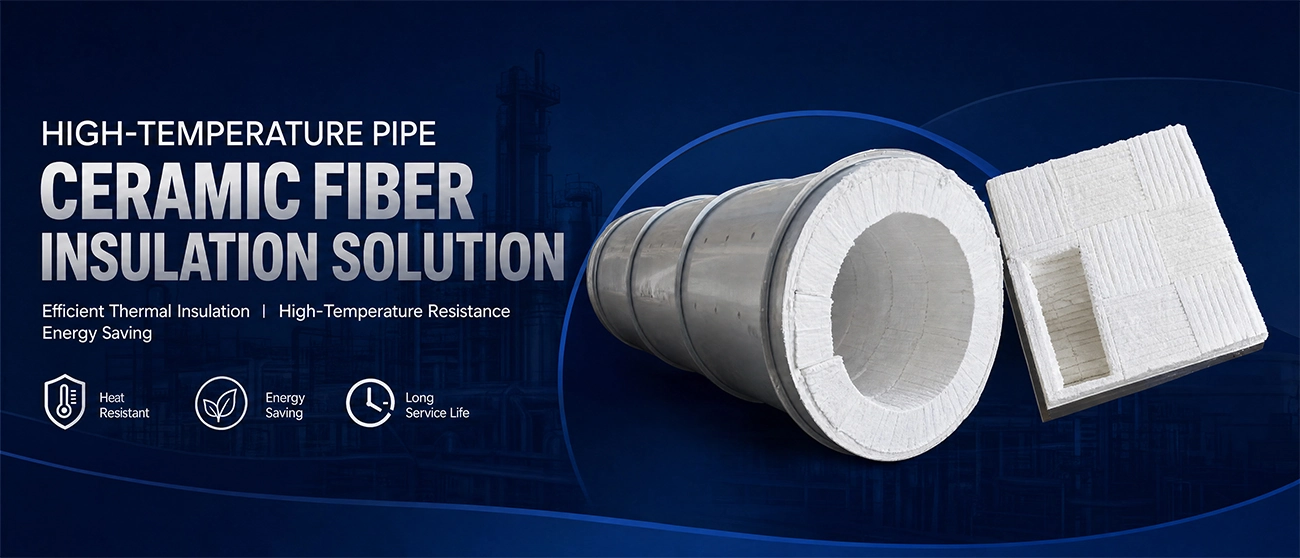
Ceramic fiber insulation for pipelines is manufactured from the same family of refractory fiber materials used in furnace and kiln lining — alumina-silicate or higher-purity alumina fibers, spun or blown from a molten state and formed into products engineered specifically for wrapping, sealing, and insulating cylindrical and irregular piping geometries:
Ceramic fiber products for piping applications are typically rated for continuous service temperatures from around 600°C up to 1260°C or higher, covering the vast majority of high-temperature industrial piping applications — from moderate-temperature steam lines to extreme-temperature flue gas ducting and process piping operating well above the practical limits of mineral wool, fiberglass, or calcium silicate insulation.
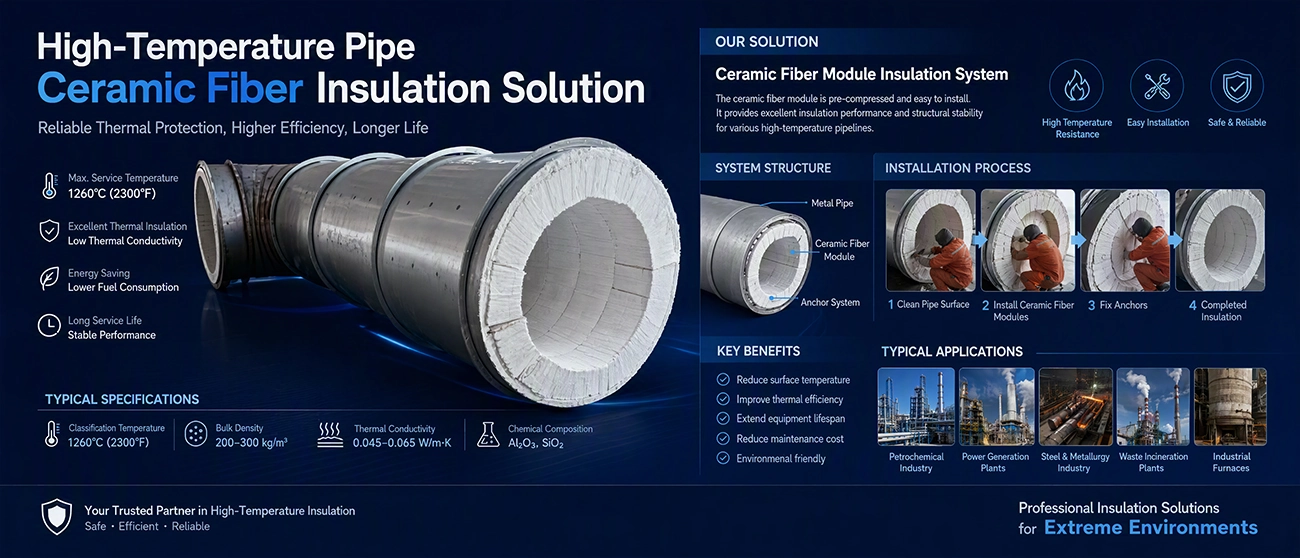
Conventional industrial pipe insulation materials each have defined upper temperature limits: fiberglass typically tops out around 450-540°C, mineral wool (rock wool) around 650-750°C, and calcium silicate around 650°C (with some grades reaching slightly higher). Ceramic fiber’s continuous service rating of up to 1260°C (standard grade) or higher (high-purity grades) makes it one of the few practical insulation choices for the highest-temperature piping applications — flue gas ducts, furnace outlet piping, high-pressure superheated steam lines, and process piping operating above 650°C.
Ceramic fiber maintains low thermal conductivity even at its upper temperature ratings, where many alternative materials begin to lose insulating effectiveness or approach structural limits. This ensures consistent, predictable heat loss performance across the full length of a pipeline run, even where temperature varies from section to section.
Unlike rigid pre-formed insulation products, ceramic fiber blanket, rope, and cloth conform easily to elbows, tees, valves, flanges, expansion joints, and other irregular fittings that make up a significant portion of any real-world piping system — areas where rigid insulation often requires extensive field fabrication or leaves insulation gaps that become significant heat-loss and safety hot spots.
Piping systems subject to thermal cycling (start-stop process operations), vibration (piping near rotating equipment, or subject to flow-induced vibration), or occasional thermal transients benefit from ceramic fiber’s flexible fiber structure, which resists the cracking and disintegration that can affect more rigid insulation materials under repeated mechanical and thermal stress.
Ceramic fiber’s low density significantly reduces the weight added to piping systems and their support structures compared to denser insulation materials — an important consideration for long pipe runs, elevated pipe racks, and piping systems with limited structural support capacity.
Properly installed ceramic fiber pipe insulation, typically finished with an appropriate outer cladding or jacket, reduces external surface temperature to safe touch levels, helping facilities meet workplace safety standards for hot surface contact protection in areas accessible to personnel.
While ceramic fiber itself is chemically inert and does not promote corrosion, proper system design — including appropriate vapor barriers where applicable, weatherproof outer cladding, and attention to moisture ingress points — remains important for any high-temperature piping insulation system, ceramic fiber included, to manage the broader industry concern of corrosion under insulation on the underlying pipe or duct steel.
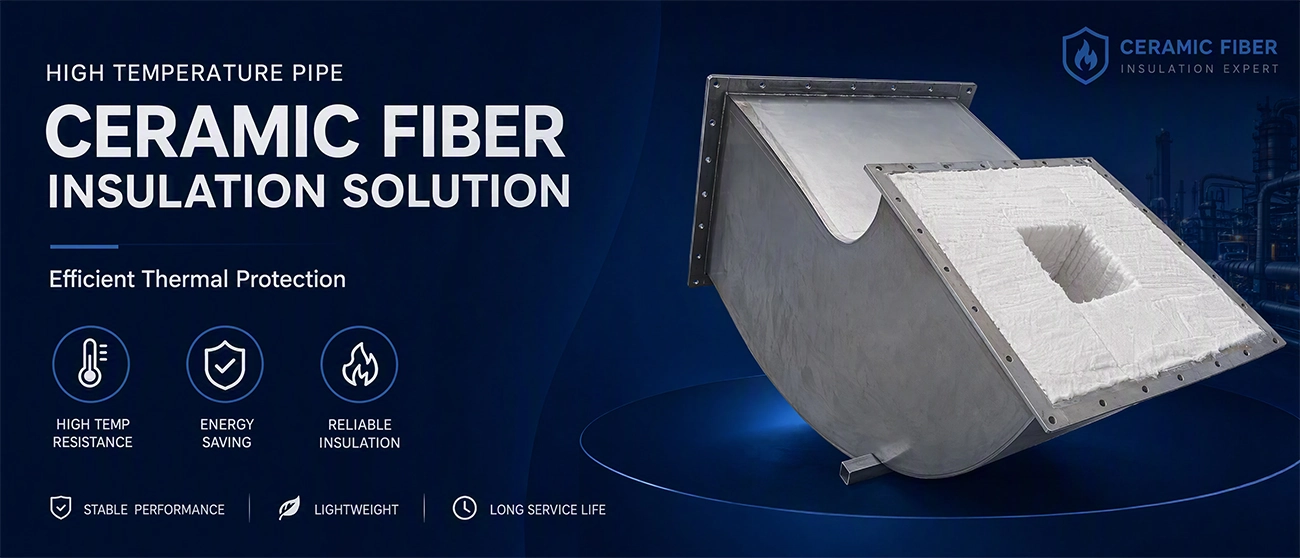
Steam piping, superheater and reheater lines, main steam headers, flue gas ducting between boiler, economizer, air heater, and stack, and turbine casing insulation all commonly use ceramic fiber, particularly in sections operating at the highest end of the plant’s temperature range where fiberglass or mineral wool would exceed rated limits. High-temperature flue gas ductwork connecting boilers to emission control equipment (ESPs, SCR units, baghouses) is a particularly common ceramic fiber application given the combination of high temperature and large duct surface area involved.
Fired heater outlet piping, transfer lines between process units operating at elevated temperature, reformer and cracker furnace connecting piping, and high-temperature process vessel insulation throughout refineries and petrochemical complexes rely heavily on ceramic fiber for the highest-temperature circuits, often in combination with mineral wool or calcium silicate for lower-temperature sections of the same overall piping network.
Piping and ductwork connecting reheating furnaces, annealing lines, and other high-temperature metal processing equipment to downstream emission control or heat recovery systems frequently operates in the temperature range where ceramic fiber is the only practical insulation choice, particularly on gas offtake ducting from furnaces and kilns.
Kiln exhaust ductwork, preheater tower connecting ducts, and high-temperature gas transfer piping in cement and lime production facilities operate at temperatures and with dust-laden, often chemically aggressive gas streams that make ceramic fiber’s high-temperature stability and chemical resistance particularly valuable.
Flue gas ducting between combustion chambers, heat recovery boilers, and emission control equipment in waste incineration facilities frequently operates at high, variable temperatures depending on waste feed characteristics, making ceramic fiber’s thermal shock resistance and high-temperature margin particularly important for reliable, low-maintenance insulation performance.
While the majority of district heating pipeline runs operate at moderate temperatures well within the range of conventional insulation, the highest-temperature sections near CHP plants, boiler headers, and steam distribution points often use ceramic fiber, particularly at pipe penetrations, expansion joints, and valve stations where flexible, high-temperature-rated insulation is needed.
High-temperature ducting connecting glass melting furnaces to regenerators, waste heat recovery systems, and emission control equipment operates at temperatures requiring ceramic fiber insulation, given the sustained, continuous high-temperature nature of glass furnace operation.
Process piping carrying high-temperature reaction products, high-temperature reactor connecting piping, and thermal oxidizer ducting in chemical manufacturing facilities frequently specify ceramic fiber for circuits exceeding the practical limits of standard industrial insulation materials.
Exhaust and offtake piping from industrial furnaces used in aerospace component processing, automotive parts heat treatment, and similar manufacturing applications commonly use ceramic fiber for the high-temperature ducting connecting furnaces to downstream filtration or heat recovery equipment.
Regardless of the specific industry, valves, flanges, and expansion joints represent some of the most difficult-to-insulate points in any high-temperature piping system, due to their irregular shape and the frequent need for removable insulation to permit maintenance access. Ceramic fiber blanket, cloth, and custom-fabricated removable insulation jackets are widely used specifically for these components across virtually every high-temperature piping application described above.
Ceramic fiber blanket is cut to size and wrapped directly around straight pipe runs, elbows, and other fittings in the field, then secured with stainless steel banding, wire, or pins, and typically finished with an outer metal cladding (aluminum or stainless steel) or weatherproof jacket for mechanical and environmental protection. This remains the most common and flexible installation method, particularly for retrofit projects, irregular piping configurations, and facilities where standardized pre-formed sections aren’t practical.
For new construction or major piping replacement projects involving long runs of standard-diameter straight pipe, pre-formed rigid or semi-rigid ceramic fiber pipe sections offer faster installation, more consistent insulation thickness, and reduced field labor compared to blanket wrapping — though fittings, valves, and irregular geometry still typically require blanket, cloth, or custom-fabricated components.
For valves, flanges, expansion joints, and other components requiring periodic access for maintenance or inspection, custom-fabricated removable insulation covers — typically constructed from ceramic fiber blanket encased in a durable outer fabric (such as silicone-coated fiberglass cloth) with hook-and-loop or lacing closures — provide full insulating performance while allowing quick removal and reinstallation without damaging or discarding the insulation material.
For the highest-temperature applications, or where long-term durability is critical, multi-layer ceramic fiber systems — combining a higher-density, higher-temperature-rated inner layer directly against the pipe or duct surface with a lower-density outer layer — optimize both thermal performance and material cost across the full temperature gradient from the hot pipe surface to the ambient-temperature outer cladding.
Ceramic fiber rope and cord products seal expansion joints, valve stem penetrations, and other gaps in the insulation system where blanket or pre-formed sections cannot provide a complete seal, preventing localized heat loss and hot spots at these transition points.
Work with an experienced industrial insulation contractor or engineering team familiar with high-temperature piping insulation design, particularly for large-scale projects spanning multiple temperature zones and piping configurations.
Map the piping system’s temperature profile — identify which sections require ceramic fiber’s high-temperature capability versus sections where alternative materials may be more cost-effective.
Identify fitting-heavy and maintenance-access areas — valves, flanges, and expansion joints typically warrant removable ceramic fiber jacket systems rather than fixed blanket or pre-formed sections.
Calculate required insulation thickness for your specific energy efficiency and/or personnel protection targets, accounting for pipe diameter, temperature, and ambient/outdoor exposure conditions.
Specify appropriate outer cladding and weatherproofing matched to the installation environment (indoor, outdoor, corrosive atmosphere, etc.).
Plan installation method — field-wrapped blanket for retrofit and irregular geometry, pre-formed sections for new straight-run construction, and custom jackets for components requiring maintenance access.
 ceramicfiber

提交产品咨询
我们将会在24小时内联系您