Search the whole station
CVD (Chemical Vapor Deposition) and PECVD (Plasma-Enhanced Chemical Vapor Deposition) furnaces demand a level of thermal chamber precision, cleanliness, and process compatibility that general-purpose furnace insulation simply isn’t engineered to deliver. Every deposition run depends on a stable, uniform, contamination-free thermal environment — and the insulation lining surrounding the process chamber plays a direct role in whether that environment is achievable, repeatable, and free of the particulate or chemical interference that can compromise film quality, wafer yield, or process repeatability.
We supply high-purity ceramic fiber insulation systems specifically engineered for CVD and PECVD furnace chamber construction, addressing the combination of requirements unique to vapor deposition processing: low alkali and flux content to minimize contamination risk, low thermal mass for fast, precisely controlled ramp rates, dimensional stability under repeated thermal cycling, and compatibility with the process gas chemistries and, where applicable, vacuum or reduced-pressure conditions typical of CVD and PECVD operation.
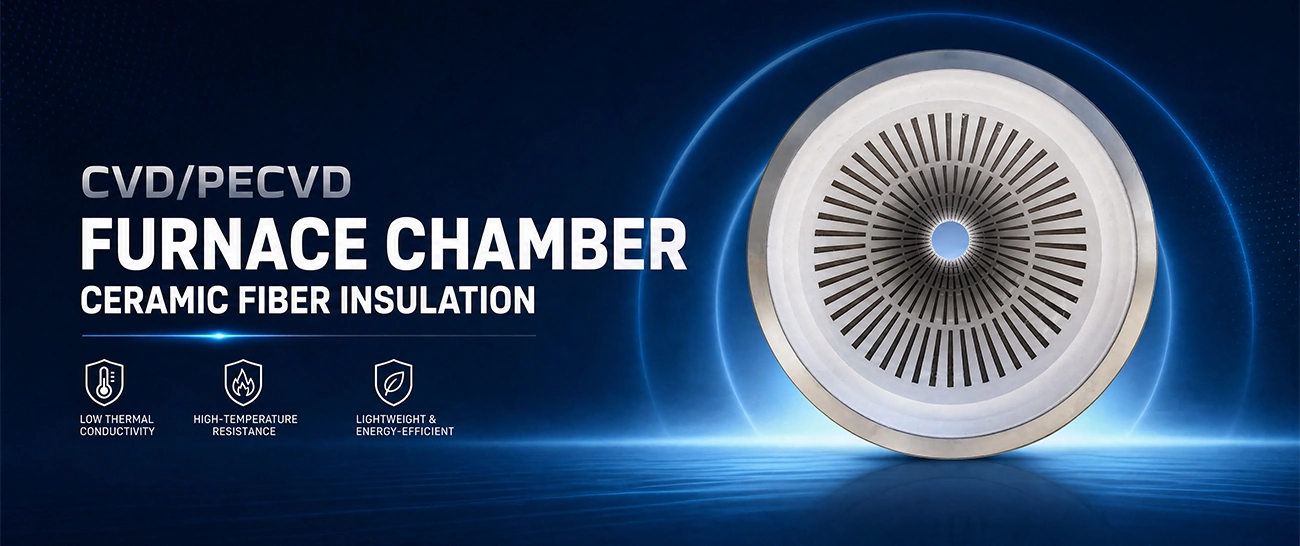
General industrial furnace insulation is optimized primarily around thermal efficiency and mechanical durability. CVD and PECVD chamber insulation has to satisfy those same basic thermal requirements while also meeting a second, equally demanding set of criteria specific to vapor deposition processing:
Standard industrial-grade ceramic fiber, while excellent for general furnace applications, is not necessarily formulated or manufactured to the purity and outgassing specifications that CVD/PECVD chamber applications require. This is why deposition equipment manufacturers and process engineering teams typically specify insulation grades and product forms selected specifically for this application category, rather than defaulting to general-purpose industrial furnace insulation.
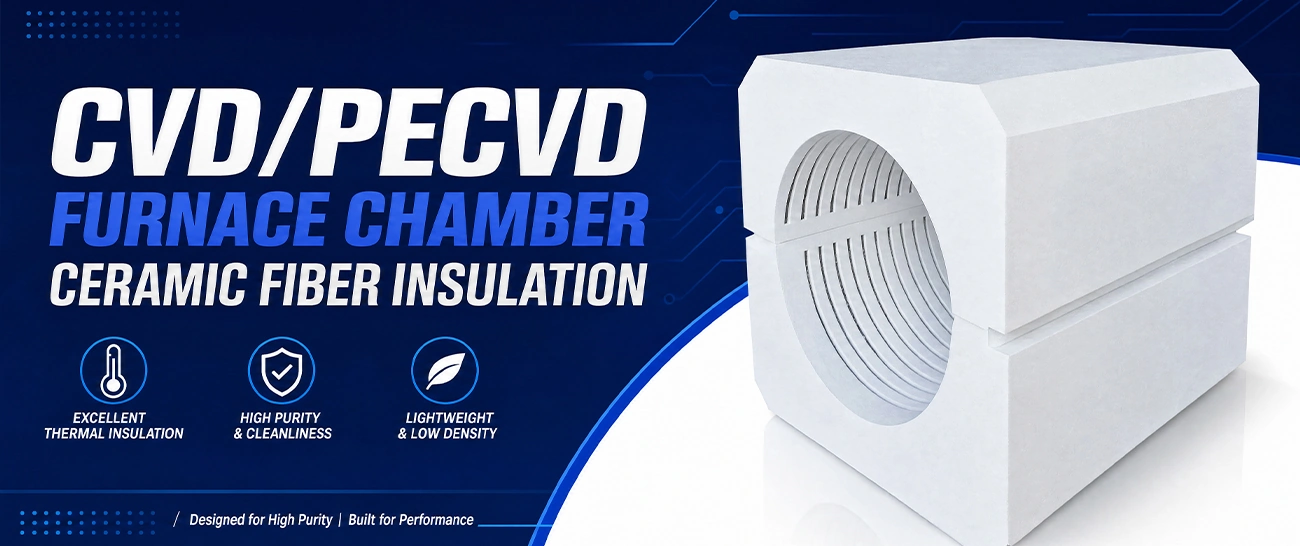
Insulation intended for CVD/PECVD chamber use should be manufactured from high-purity alumina-silicate or polycrystalline alumina fiber with tightly controlled alkali content (Na2O, K2O) and minimized flux impurities. Standard commercial-grade ceramic fiber, formulated primarily for cost-effective general industrial insulation, typically carries higher impurity levels than is appropriate for contamination-sensitive deposition environments — purity specification should be an explicit part of your material selection process, not an assumed default.
Because deposition processes are highly sensitive to unintended gas-phase species — whether from residual moisture, organic binder decomposition, or volatile impurities within the insulation itself — chamber insulation should be selected and, where necessary, pre-conditioned (baked out) to minimize outgassing contribution during process operation. Binder-free or low-binder-content ceramic fiber products are generally preferable in the chamber-adjacent zones of deposition furnace construction, since organic binder decomposition during initial heat-up is a common source of unwanted outgassing in furnace equipment more broadly.
CVD and PECVD process recipes frequently specify particular heating and cooling ramp rates as part of achieving target film properties, and multi-step recipes may require the chamber to transition through several temperature setpoints within a single run. Low-thermal-mass ceramic fiber insulation directly supports this requirement, allowing the chamber to respond quickly and predictably to heater power changes rather than lagging behind the commanded setpoint due to the thermal inertia of a heavier insulation structure.
Deposition rate and film thickness uniformity across a wafer or substrate are directly sensitive to temperature uniformity within the process zone. Insulation design — including consistent thickness, minimized gaps or joints that could create localized heat loss paths, and, in multi-zone furnace designs, effective thermal isolation between adjacent independently controlled zones — plays a direct role in achieving and maintaining the tight temperature uniformity specifications many deposition processes require.
Production deposition equipment typically runs many process cycles per day or week, each involving a heat-up and cool-down cycle. Insulation shrinkage or structural degradation over repeated thermal cycling directly translates into drifting thermal performance over the equipment’s operating life — meaning shrinkage-resistant, high-temperature-stable fiber formulations are particularly important for the high-cycle-count operating profile typical of production deposition tools, as opposed to less frequently cycled general industrial furnace applications.
Depending on the specific CVD or PECVD process — silicon nitride, silicon dioxide, amorphous silicon, various metal or metal-oxide films, and others — the chamber-adjacent insulation may face exposure to reactive precursor gases and reaction byproducts. Material selection should account for the specific process chemistry involved, since chemical compatibility requirements can vary meaningfully between different deposition process types.
Many PECVD processes, and some CVD processes, operate under vacuum or reduced-pressure conditions. Insulation materials and construction methods used in these zones should be evaluated for compatibility with the vacuum environment, including consideration of trapped-gas outgassing behavior under reduced pressure, which can differ from atmospheric-pressure outgassing characteristics.
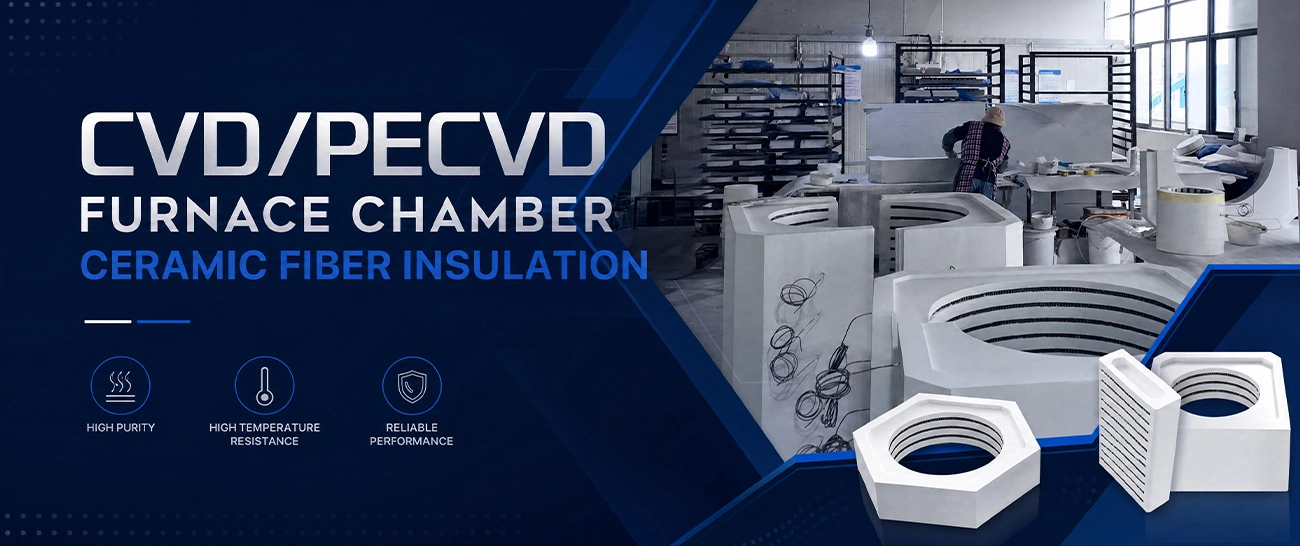
Custom vacuum-formed high-purity ceramic fiber shapes, molded directly to the specific chamber geometry, provide a seamless, precisely fitted lining with minimal joints — reducing both localized heat loss paths and the number of edge/joint locations that can be a source of particulate generation over repeated thermal cycling.
Rigid, high-purity ceramic fiber board is used where a more mechanically stable hot-zone surface is beneficial, such as chamber floors or mounting surfaces for internal fixtures, susceptors, or heating elements, while maintaining the low-mass, low-impurity characteristics required for deposition chamber use.
Flexible high-purity blanket is used as a secondary insulation layer behind a rigid hot-face liner, and is particularly valuable in multi-zone furnace designs for wrapping and thermally isolating the boundary between independently controlled heating zones, minimizing cross-zone thermal interference that could otherwise degrade zone-to-zone temperature control precision.
Where chamber sealing or component isolation is required within or near the heated zone, high-purity ceramic fiber paper or gasketing products, selected for minimized binder content and outgassing characteristics, provide sealing performance without introducing an outsized contamination or outgassing risk relative to the surrounding chamber materials.
For applications with particularly stringent outgassing requirements, insulation components can be specified with a pre-conditioning bake-out step performed prior to installation, reducing the initial outgassing burden that would otherwise occur during the furnace’s first operational heat-up cycles.
CVD and PECVD furnaces used in semiconductor fabrication — for silicon nitride, silicon dioxide, polysilicon, and various dielectric and thin-film deposition steps — represent the most contamination- and outgassing-sensitive application category for this insulation type, where film purity and process repeatability directly affect device yield.
PECVD deposition of anti-reflective coatings, passivation layers, and other thin films in photovoltaic cell manufacturing relies on furnace equipment with the thermal uniformity and process repeatability that high-purity, low-outgassing chamber insulation supports, particularly in high-throughput production environments running continuous cycling.
Metal-organic chemical vapor deposition (MOCVD) systems, used in compound semiconductor and LED manufacturing, involve process chemistries and thermal precision requirements that similarly benefit from high-purity, low-thermal-mass chamber insulation design.
Research and pilot-scale CVD/PECVD systems used in materials science and thin-film coating development benefit from the same insulation characteristics — fast, precise thermal cycling and minimized contamination risk — supporting reliable, repeatable experimental results across research programs evaluating new film chemistries or process conditions.
Tube furnace-based CVD reactors, widely used in both research and specialty production settings, use high-purity ceramic fiber insulation surrounding the process tube to minimize thermal mass around the reaction zone, supporting the precise temperature ramping these systems require while limiting insulation-derived contamination risk to the samples or substrates being processed inside the tube.
While ALD systems have their own specific chamber design considerations, furnace and heater block insulation in ALD-adjacent thermal processing equipment benefits from similar high-purity, low-outgassing material selection principles where thermal uniformity and contamination control are process-critical.
Define your process temperature profile — including maximum operating temperature, required ramp rates, and any multi-step or multi-zone temperature requirements — to determine appropriate classification grade and thermal mass targets.
Specify your contamination tolerance — the acceptable alkali/impurity level and outgassing specification for your specific process (semiconductor-grade requirements, for example, are typically more stringent than general materials research applications) should be explicitly defined rather than assumed.
Identify your chamber geometry — tube furnace, horizontal reactor, vertical reactor, or custom chamber design each favor different combinations of vacuum-formed shapes, board, and blanket for optimal fit and performance.
Confirm process gas compatibility requirements — the specific precursor gases and reaction byproducts involved in your CVD/PECVD process should inform any chemical compatibility evaluation needed for chamber-adjacent insulation materials.
Evaluate vacuum/pressure regime compatibility — for PECVD and reduced-pressure CVD processes, confirm that selected insulation materials and construction methods are appropriate for your specific operating pressure range.
Plan for multi-zone thermal isolation — if your furnace design involves multiple independently controlled heating zones, insulation placement and design at zone boundaries should be specifically engineered to minimize cross-zone thermal interference.
Our technical team works directly with furnace OEMs and process engineering teams to review process requirements — temperature profile, contamination tolerance, chamber geometry, and gas chemistry — and recommend the appropriate high-purity ceramic fiber material selection and product form combination for your specific CVD/PECVD application.
| Ceramic Fiber Heating Module | XMF-1100 | XMF-1200 | XMF-1300 | XMF-1400 | XMF-1500 | XMF-1600 | |
| Working Temperature(℃) | 1100 | 1200 | 1350 | 1500 | 1600 | 1700 | |
| Density(kg/m³) | 300-600 | 300-600 | 300-600 | 300-600 | 450-700 | 450-700 | |
| Linear Shrinkage(24H) (After Burning) (%) | ≤3.0 (1100℃) | ≤3.0 (1250℃) | ≤3.0 (1300℃) | ≤1.0 (1450℃) | ≤1.0 (1550℃) | ≤1.0 (1650℃) | |
| Thermal Conductivty Rate (W/m.k) | 400℃ | 0.084 | 0.084 | 0.084 | / | / | / |
| 800℃ | 0.128 | 0.125 | 0.125 | 0.160 | 0.160 | 0.160 | |
| 1000℃ | 0.176 | 0.174 | 0.200 | 0.210 | 0.210 | 0.210 | |
| Heating Element | Resistance wire | SiC heating element | SiC heating element | MoSi2 heating element | MoSi2 heating element | MoSi2 heating element | |
| Furnace Chamber Size | Customized | Customized | Customized | Customized | Customized | Customized | |
| The sizes and packaging can be customized according to your needs | |||||||
Get Started Free Call?
TEL: +8618638681557
E-mail: info@yexintech.com
Standard industrial ceramic fiber is formulated primarily for general thermal insulating performance and cost-effectiveness, typically carrying higher alkali and impurity content than is appropriate for contamination-sensitive deposition applications. High-purity, low-outgassing formulations are specifically engineered to minimize the risk of process contamination and unwanted gas-phase interference that standard-grade material could introduce.
Chemical compatibility depends on the specific insulation formulation and the specific process gas chemistry involved. We recommend discussing your specific precursor gases and process conditions with our technical team to confirm appropriate material selection for your application.
Insulation thickness consistency, minimized joints and gaps, and effective thermal isolation between multi-zone furnace sections all directly influence how evenly heat is distributed across the process zone, which in turn affects deposition rate and film thickness uniformity across the substrate.
The core insulation requirements — purity, low outgassing, low thermal mass, dimensional stability — are similar across both process types. PECVD systems more commonly involve vacuum or reduced-pressure operation, which adds an additional consideration around outgassing behavior under reduced pressure that should be specifically evaluated for PECVD chamber applications.
Yes, we work with both furnace OEMs specifying insulation for new equipment builds and end users planning chamber relining or insulation upgrades on existing CVD/PECVD equipment.
 ceramicfiber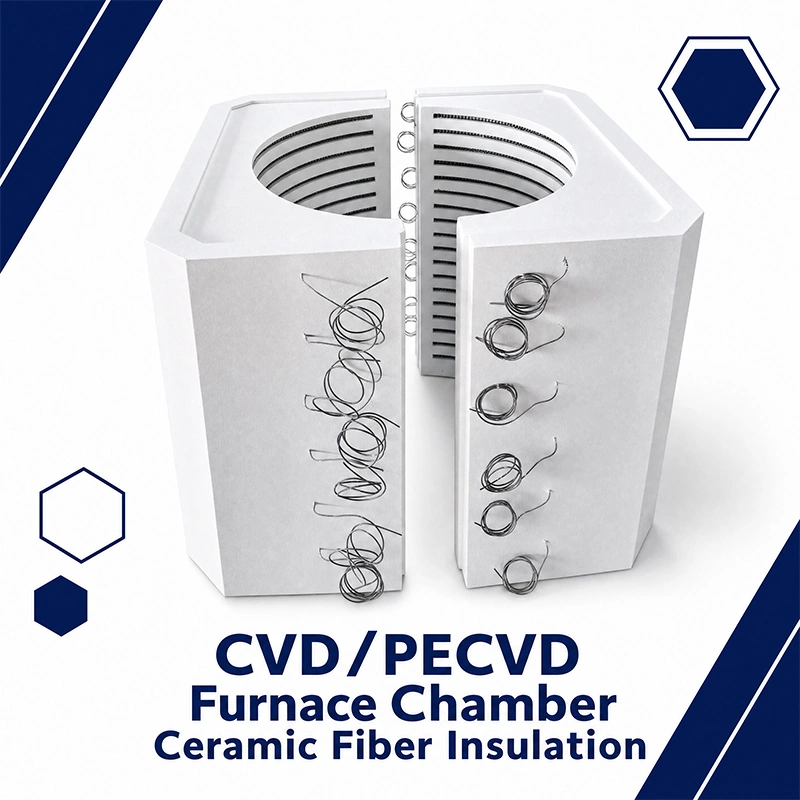

提交产品咨询
我们将会在24小时内联系您