Search the whole station
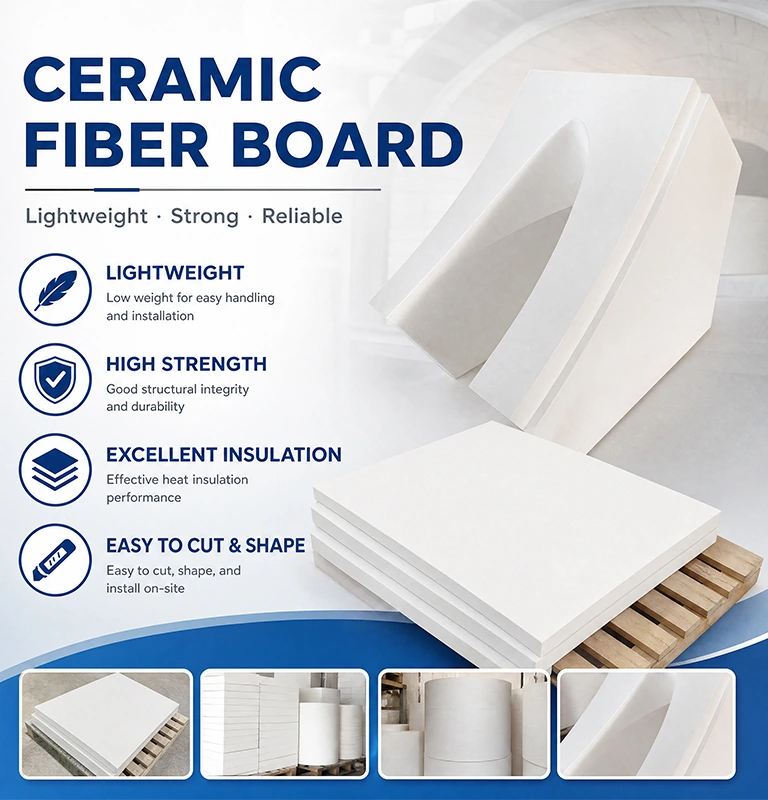
Industries that operate furnaces, kilns, boilers, and other high-temperature equipment face a constant engineering challenge: how to contain extreme heat efficiently while protecting structural components, controlling energy costs, and keeping outer surfaces safe to work around. Ceramic fiber board has become one of the most widely used solutions to this challenge, offering a rigid, lightweight, and highly heat-resistant insulation material that performs reliably in some of the harshest thermal environments in industry.
From steel mills and glass furnaces to petrochemical plants, aerospace manufacturing, and kiln construction, ceramic fiber board plays a critical role in reducing heat loss, protecting structural steel and refractory linings, and improving overall process efficiency.
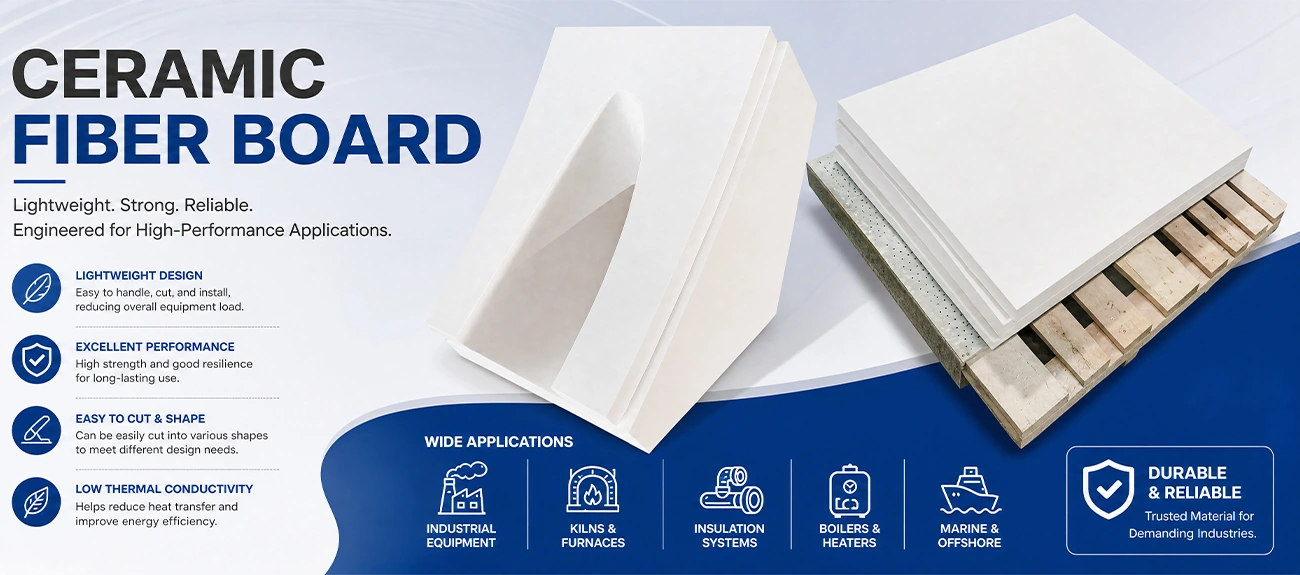
Ceramic fiber board is a rigid, lightweight insulation panel made by combining ceramic fibers with binders and other additives, then vacuum-forming or pressing the mixture into flat panels. The base fibers are typically produced from high-purity alumino-silicate materials, and in higher-temperature grades, zirconia is often added to the fiber composition to extend the board’s maximum service temperature.
The manufacturing process generally begins with blending the raw ceramic fibers into a wet slurry, which is then formed into flat boards using a vacuum-forming process. After forming, the boards are dried and, in many cases, cured or heat-treated to achieve their final rigidity, mechanical strength, and dimensional stability. Compared to loose ceramic fiber bulk or flexible ceramic fiber blanket, board form offers greater structural rigidity, making it easier to cut, machine, and install as a self-supporting insulation component.
Because of its combination of low thermal conductivity, resistance to thermal shock, and ease of fabrication, ceramic fiber board has become a practical alternative to traditional firebrick in many applications, while offering significant weight savings and faster installation.
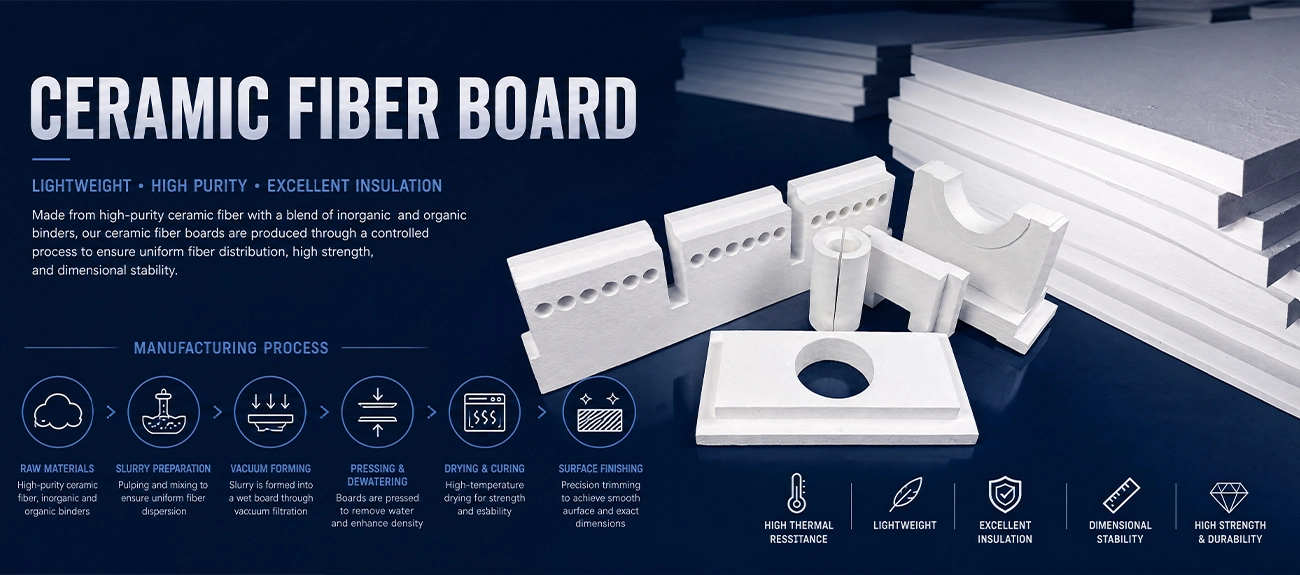
Understanding the manufacturing process helps explain why ceramic fiber board performs so well in high-heat environments.
Fiber blending. High-purity alumino-silicate fibers (and zirconia-containing fibers for higher-temperature grades) are carefully blended with binders to ensure uniform fiber distribution throughout the finished board. Even distribution is essential for consistent thermal and mechanical performance across the entire panel.
Vacuum forming. The blended fiber slurry is drawn through a forming screen under vacuum pressure, which compacts the fibers into a uniform wet mat while draining excess liquid. This vacuum-forming process is what gives ceramic fiber board its uniform density, ensuring the material’s properties stay consistent across every part of the board.
Drying and curing. After forming, the boards go through a drying stage, and in many manufacturing processes, a curing step follows to enhance mechanical strength and prepare the board for high-temperature service. Some manufacturers use rapid drying cycles to further improve compressive strength before the boards are cut to final dimensions.
Cutting and finishing. Once cured, boards are trimmed to standard sheet sizes and specified thicknesses. Because the material remains machinable after curing, manufacturers and end users can further cut, drill, or shape boards to fit custom applications.
This vacuum-forming approach offers a distinct advantage over older pressed or cast alternatives: it produces a more uniform microstructure, which translates into more predictable thermal conductivity and more consistent mechanical strength, along with smoother board surfaces that are particularly valuable in applications involving direct flame contact or gas flow.
Several physical and thermal characteristics make ceramic fiber board a preferred insulation material across a wide range of industries:
High-temperature resistance. Depending on the fiber composition and grade, ceramic fiber boards are commonly rated for continuous service temperatures ranging from around 1260°C (2300°F) up to 1430°C (2600°F) or higher for premium zirconia-enhanced grades.
Low thermal conductivity. The fibrous, air-filled structure of ceramic fiber board significantly slows the transfer of heat from the hot face to the cold face, helping maintain lower external surface temperatures and improving overall energy efficiency.
Excellent thermal shock resistance. Ceramic fiber board can withstand rapid temperature fluctuations without cracking or degrading, a critical property in applications with frequent heating and cooling cycles, such as batch kilns or intermittently operated furnaces.
Low heat storage (low thermal mass). Because the material has a relatively low density and low thermal mass compared to traditional firebrick, it absorbs and stores less heat, allowing equipment to reach operating temperature faster and cool down more quickly, which can translate into meaningful energy savings in cyclical operations.
Lightweight construction. Ceramic fiber board is dramatically lighter than firebrick or castable refractory of comparable insulating value, which reduces structural loading on furnace frameworks, simplifies transport, and speeds up installation.
Chemical and corrosion resistance. Ceramic fiber board generally resists a range of corrosive chemicals and does not readily react with most process gases, making it suitable for environments where chemical exposure is a concern.
Mechanical strength and machinability. Vacuum-formed boards offer meaningful flexural and compressive strength, allowing them to perform in mechanically demanding locations such as furnace roofs, kiln furniture, and burner blocks, while still being soft enough to cut, drill, and shape with standard woodworking or metalworking tools.
Sound absorption. The porous fiber structure also provides a degree of acoustic dampening, which can be a secondary benefit in certain industrial noise-control applications.
Ceramic fiber board is typically offered in several grade families that differ by alumina content, fiber type, and density, allowing users to match the board to their specific temperature and mechanical requirements.
Standard grade (around 1260°C / 2300°F). This is the most widely used grade for general industrial insulation, offering a strong balance of thermal performance and cost efficiency for furnace linings, kiln construction, and general heat containment.
High-temperature grade (around 1430°C / 2600°F). Formulated with modified fiber chemistry, often including added alumina or zirconia content, these boards are designed for more demanding thermal cycling environments such as heat-treating furnaces, ceramic kilns, and metal foundries, where they resist structural deformation and maintain insulating performance over longer service periods.
Density variations. Within each temperature grade, boards are typically available in a range of densities. Lower-density boards generally offer better insulating value and are often used as cold-face or backup insulation, while higher-density, higher-strength boards are selected for locations where the board must withstand physical loading, such as furnace walls, kiln cars, and structural insulation components.
Buyers should always confirm the specific temperature rating, density, and thickness options available from a given manufacturer, since terminology and exact performance specifications can vary between suppliers.
Ceramic fiber board’s combination of light weight, low thermal conductivity, and machinability makes it a versatile material used across many industries.
Furnace and kiln construction. Ceramic fiber board is widely used to line the walls, roofs, and doors of industrial furnaces and kilns, including chamber kilns, shuttle kilns, and roller kilns, helping equipment heat up faster while keeping outer shell temperatures cooler and more stable.
Backup insulation for refractory linings. In many high-temperature furnaces, ceramic fiber board is installed behind hot-face refractory brick or castable material, protecting structural steel from excess heat and extending the service life of the primary refractory lining.
Boilers and combustion chambers. The material is commonly used to build or repair combustion chambers and fireboxes in oil, gas, and solid-fuel boilers and furnaces, including components such as target walls and burner blocks.
Heat-treating and reheating furnaces. In steel and metal processing plants, ceramic fiber board is used in heat-treatment furnace linings, reheating furnace insulation, and induction furnace covers, supporting energy efficiency and consistent process temperatures.
Aerospace and automotive components. Ceramic fiber board contributes to insulation and thermal management systems in aerospace construction, as well as heat shields and exhaust insulation in vehicles, where controlling extreme, localized heat is essential for safety and performance.
Kiln furniture and casting applications. Because of its machinability and mechanical strength, ceramic fiber board is also used to fabricate kiln furniture, casting setters, casting tips, and splash guards in metal casting operations.
Expansion joints and seals. Thin ceramic fiber board sections are frequently used as compressible seals or expansion joint material between refractory sections, accommodating thermal expansion while maintaining a continuous insulation barrier.
Compared to conventional firebrick and castable refractory, ceramic fiber board offers several practical advantages that explain its growing adoption across high-temperature industries:
Significant weight reduction. Ceramic fiber board is far lighter than firebrick of equivalent insulating capacity, which reduces the structural support required for furnace construction and lowers transportation and handling costs.
Faster installation. Rigid boards can be cut to precise dimensions and installed more quickly than laying and curing brick or castable refractory, which can shorten equipment downtime during construction, relining, or repair projects.
Better energy efficiency. Lower thermal mass and lower thermal conductivity generally translate into reduced energy consumption, both because less heat is stored in the insulation itself and because less heat escapes to the surrounding environment.
Design flexibility. Because the material is easily machinable, ceramic fiber board can be adapted to custom shapes, cutouts, and complex geometries that would be difficult or costly to achieve with brick construction.
Reduced thermal shock damage. Facilities running processes with frequent heating and cooling cycles benefit from ceramic fiber board’s resistance to cracking under thermal shock, reducing maintenance frequency compared to more brittle refractory materials.
Getting the full performance benefit from ceramic fiber board depends not only on selecting the right grade, but also on proper installation. A few widely recommended practices can help extend service life and maintain insulating performance:
Plan joints and seams carefully. Because ceramic fiber board is rigid, panels must be fitted together with attention to joint placement, since gaps or misaligned seams can create localized hot spots or heat leakage paths. Staggering joints between layers, where multiple board layers are used, helps minimize continuous through-paths for heat transfer.
Account for thermal expansion. High-temperature equipment expands and contracts during heating and cooling cycles. Installers often incorporate expansion allowances or use compressible fiber sections at joints to prevent boards from buckling, cracking, or pulling away from anchor points as the structure moves.
Use appropriate anchoring systems. Depending on the application, ceramic fiber board may be secured using refractory anchors, adhesives, or mechanical fasteners rated for high-temperature service. Choosing an anchoring method compatible with both the board and the surrounding structure helps prevent premature failure.
Avoid compressing boards beyond their rated tolerance. While ceramic fiber board can accommodate some compression at seams, excessive compression during installation can alter the material’s density and insulating properties in localized areas, potentially reducing performance.
Coordinate with the overall refractory system. In multi-layer furnace or kiln linings, ceramic fiber board is often just one component alongside firebrick, castable refractory, or ceramic fiber blanket. Coordinating board placement with these other materials, according to the original engineering design, helps ensure the complete insulation system performs as intended.
Many manufacturers and refractory engineering firms offer installation guidance or on-site technical support for large or complex projects, which can be particularly valuable when integrating ceramic fiber board into an existing furnace or kiln structure during a relining or upgrade.
| Model | YXN-1260B | YXN-1400B | YXN-1500B | YXN-1600B | YXN-1700B | YXN-1800B | YXN-1900B |
|---|---|---|---|---|---|---|---|
| Classification temperature (°C) | 1260 | 1400 | 1500 | 1600 | 1700 | 1800 | 1900 |
| Working Temperature | 1000 | 1200 | 1350 | 1500 | 1600 | 1700 | 1750 |
| Color | white | white | white | white | white | white | white |
| Bulk density (kg/m³) | 250~400 | 250~400 | 300~400 | 400 | 400 | 400~500 | 700 |
| Al2O3 (%) | 43 | 45 | 60 | 64 | 75 | 80 | 87 |
| Al2O3+SiO2 (%) | 98 | 98 | 98 | 98 | 99 | 99.5 | 99.5 |
| BaO (%) | <0.2 | <0.2 | <0.2 | <0.1 | <0.05 | <0.05 | <0.05 |
| shrink (%) | 1100°C*24h | 1200°C*24h | 1400°C*24h | 1500°C*24h | 1600°C*24h | 1700°C*24h | 1750°C*24h |
| Shrinkage | -3 | -2.5 | -2 | -1 | -0.5 | -0.4 | -0.1~0.4 |
| Compressive strength (MPa) -10%T | 0.3 | 0.4 | 0.5 | 0.5 | 0.6 | 0.6 | 0.8 |
| Burn reduction (%) | ≤5% | ≤5% | ≤4.5% | ≤4.5% | ≤5% | ≤3.5% | ≤4% |
Get Started Free Call?
TEL: +86 1234567
E-mail: info@xxx.com
Detailed disassembly video
A ceramic fiber gasket is used for high-temperature sealing, insulation, gasketing, and thermal protection. Common applications include furnaces, kilns, boilers, ovens, heaters, exhaust systems, and industrial access doors.
Ceramic fiber gaskets are mainly used for thermal insulation and hot gas sealing. They are usually not the best choice for high-pressure liquid sealing unless combined with other materials or designed specifically for that purpose.
Yes. Ceramic fiber gaskets can be cut into custom shapes, sizes, thicknesses, and profiles. Common custom products include flange gaskets, door seals, strips, pads, washers, and insulation frames.
Some are flexible, especially those made from ceramic fiber paper, blanket, cloth, tape, or rope. Ceramic fiber board gaskets are more rigid.
Some ceramic fiber materials contain organic binders to improve handling strength. These binders may burn out during initial heating.
 ceramicfiber
提交产品咨询
我们将会在24小时内联系您