Search the whole station
Few materials do as much heavy lifting in high-temperature industries as ceramic fiber blanket. Lightweight, flexible, and capable of withstanding continuous service temperatures up to 1430°C (2600°F), this refractory insulation product has become the default choice for furnace linings, kiln insulation, expansion joints, and countless other thermal management applications.
If you’re specifying insulation for a new furnace, replacing a worn-out lining, or simply trying to understand which refractory product fits your project, this guide covers everything you need to know about ceramic fiber blanket — what it’s made of, how it’s graded, where it’s used, and how it stacks up against related products like ceramic fiber board, ceramic fiber paper, ceramic fiber module, and ceramic fiber rope.
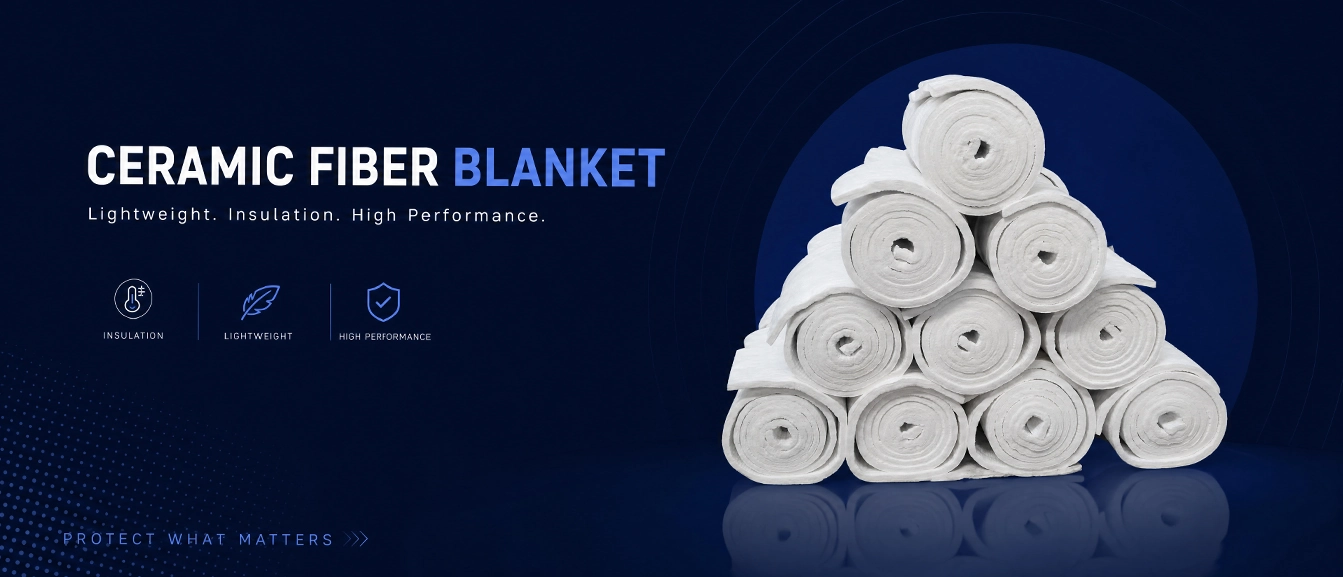
What Is Ceramic Fiber Blanket?
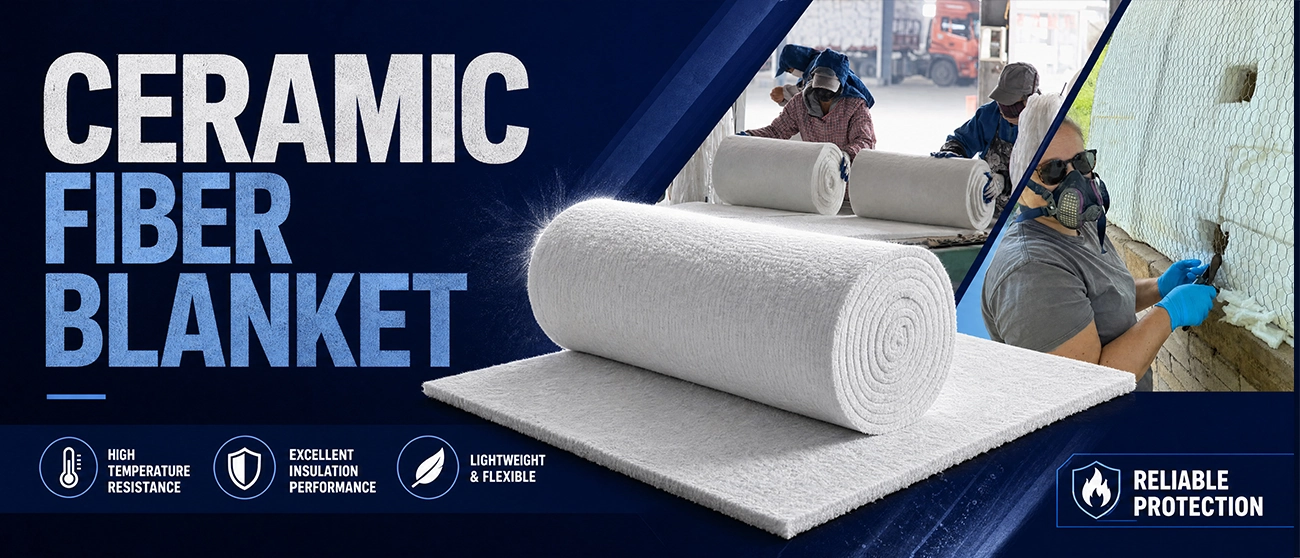
Ceramic fiber blanket is a needled, mat-like insulation material manufactured by spinning or blowing molten alumina-silica (Al₂O₃-SiO₂) into long, fine fibers, which are then cross-lapped into layers and mechanically needled to create a durable, resilient blanket. The needling process interlocks the fibers, giving the blanket tensile strength, resistance to delamination, and the flexibility to wrap around curved surfaces, pipes, and irregular furnace geometries.
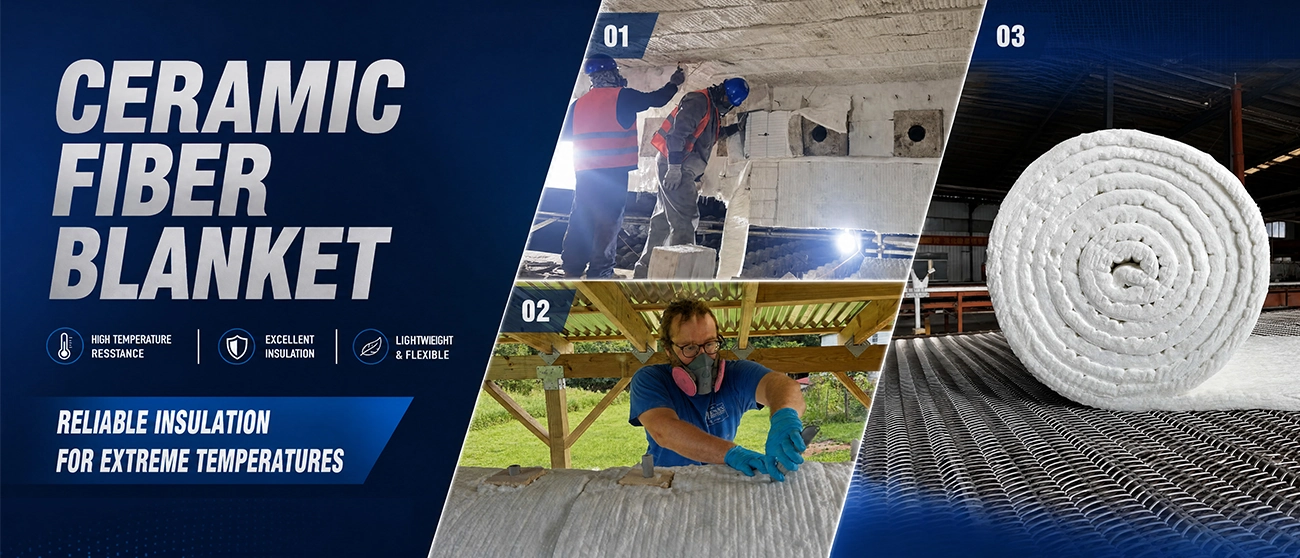
Unlike rigid insulation, ceramic fiber blanket compresses easily for shipping and installation, then springs back to its original thickness once unrolled — a property known as “recovery” that helps it maintain a tight seal even after repeated thermal cycling.
Standard ceramic fiber blanket is produced from a melt of:
For higher-temperature grades, manufacturers add zirconia (ZrO₂) to boost thermal stability, or shift to a polycrystalline alumina fiber formulation for service above 1400°C. The molten mixture is spun or blown into fibers using a centrifugal or blowing
Density and thickness are the two variables that most affect insulating performance and cost:
Thicker blankets (25mm, 38mm, 50mm) or multiple layered courses are used for higher o
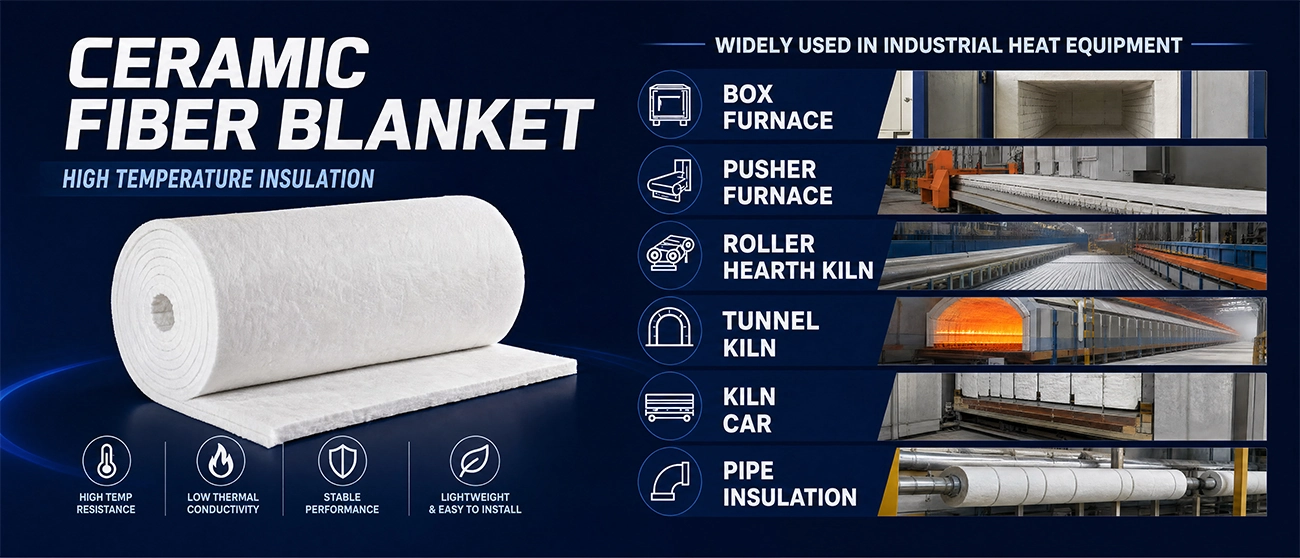
Ceramic fiber blanket is used across virtually every high-temperature industry:
Annealing and tempering furnace linings in the glass and metals industries
Furnace and kiln lining — petrochemical furnaces, ceramic kilns, glass furnaces, heat-treating furnaces
Boiler insulation — power plant boilers, industrial boilers
Expansion joints and seals — filling gaps between refractory brick sections to absorb thermal expansion
Removable insulation blankets — wrapped and sewn covers for valves, flanges, and pipe fittings in petrochemical plants
Fire protection — passive fire barriers, penetration seals, and fire-rated curtains
Aerospace and automotive — exhaust wrapping, catalytic converter mounting mats, engine bay insulation
Backup insulation — layered behind ceramic fiber board or firebrick to reduce overall system weight and cost
Ceramic fiber blanket is used across virtually every high-temperature industry:
Annealing and tempering furnace linings in the glass and metals industries
Furnace and kiln lining — petrochemical furnaces, ceramic kilns, glass furnaces, heat-treating furnaces
Boiler insulation — power plant boilers, industrial boilers
Expansion joints and seals — filling gaps between refractory brick sections to absorb thermal expansion
Removable insulation blankets — wrapped and sewn covers for valves, flanges, and pipe fittings in petrochemical plants
Fire protection — passive fire barriers, penetration seals, and fire-rated curtains
Aerospace and automotive — exhaust wrapping, catalytic converter mounting mats, engine bay insulation
Backup insulation — layered behind ceramic fiber board or firebrick to reduce overall system weight and cost
Ceramic fiber blanket has excellent insulating value, with thermal conductivity typically between 0.1–0.3 W/m·K depending on temperature and density. This means less energy loss through furnace walls and lower fuel or electricity consumption.
Because the fibers are extremely fine and the blanket itself is lightweight (typically 64, 96, 128, or 160 kg/m³ density), it stores very little heat compared to brick or castable refractories. This allows furnaces lined with ceramic fiber blanket to heat up and cool down rapidly — a major advantage for batch processes and applications requiring frequent thermal cycling.
Depending on grade, ceramic fiber blanket can withstand continuous exposure to:
| Grade | Classification Temperature | Typical Composition |
|---|---|---|
| STD (Standard) | 1260°C (2300°F) | Al₂O₃-SiO₂ |
| HP (High Purity) | 1350°C (2460°F) | Al₂O₃-SiO₂, higher purity |
| HZ (Zirconia-modified) | 1430°C (2600°F) | Al₂O₃-SiO₂-ZrO₂ |
| Polycrystalline | 1600°C+ (2912°F+) | Al₂O₃ (>72%) |
Ceramic fiber blanket doesn’t crack, spall, or degrade rapidly under sudden temperature swings — a common failure mode for rigid refractory brick.
It resists most chemical attack and doesn’t react with common furnace atmospheres, though it should be checked for compatibility with strong alkalis or hydrofluoric acid environments.
Because of its fibrous, porous structure, ceramic fiber blanket also functions as an effective acoustic insulator in high-temperature ducting and exhaust systems.
At a fraction of the weight of firebrick, ceramic fiber blanket reduces structural loading on furna
| Item | 1260 | 1260 | 1360 | 1430 | 1600 |
|---|---|---|---|---|---|
| Specification Temp. (°C) | 1260 | 1260 | 1360 | 1430 | 1600 |
| Working Temp. (°C) | 1050 | 1100 | 1200 | 1350 | 1500 |
| Bulk Density (kg/m³) | 64-160 | 64-160 | 64-160 | 64-160 | 96/128 |
| @24H | -3 | -3 | -3 | -3 | -1 |
| Linear Shrinkage after Heating | (1000°C) | (1100°C) | (1250°C) | (1350°C) | (1400°C) |
| Thermal Conductivity (w/m.k) | 0.09(400°C) | 0.09(400°C) | 0.09(400°C) | 0.09(400°C) | 0.16(600°C) |
| Thermal Conductivity (w/m.k) | 0.17(800°C) | 0.17(800°C) | 0.13(600°C) | 0.76(600°C) | 0.28(1000°C) |
| Thermal Conductivity (w/m.k) | 0.32(1000°C) | 0.31(1000°C) | 0.22(1000°C) | 0.22(1000°C) | 0.45(1400°C) |
| Tensile strength (MPa) | 0.05 | 0.05 | 0.06 | 0.06 | 0.08 |
| Al2O3 (%) | 43 | 44 | 51 | 35 | 71 |
| Al2O3 + SiO2 (%) | 96 | 98 | 99 | – | – |
| ZrO2 (%) | – | – | – | 13-15 | 13-15 |
| Fe2O3 (%) | 1.0 | 0.5 | 0.2 | 0.2 | 0.2 |
| Na2O + K2O (%) | 0.5 | 0.3 | 0.2 | 0.2 | 0.2 |
Get Started Free Call?
TEL: +86 1234567
E-mail: info@xxx.com
Detailed disassembly video
A ceramic fiber gasket is used for high-temperature sealing, insulation, gasketing, and thermal protection. Common applications include furnaces, kilns, boilers, ovens, heaters, exhaust systems, and industrial access doors.
Ceramic fiber gaskets are mainly used for thermal insulation and hot gas sealing. They are usually not the best choice for high-pressure liquid sealing unless combined with other materials or designed specifically for that purpose.
Yes. Ceramic fiber gaskets can be cut into custom shapes, sizes, thicknesses, and profiles. Common custom products include flange gaskets, door seals, strips, pads, washers, and insulation frames.
Some are flexible, especially those made from ceramic fiber paper, blanket, cloth, tape, or rope. Ceramic fiber board gaskets are more rigid.
Some ceramic fiber materials contain organic binders to improve handling strength. These binders may burn out during initial heating.
 ceramicfiber

提交产品咨询
我们将会在24小时内联系您