Search the whole station
The heart of every box furnace, muffle furnace, and laboratory chamber furnace is its insulation system. Whether you manufacture heat-treatment equipment, rebuild aging lab furnaces, or design custom kilns for advanced ceramics and metallurgy, the thermal lining determines how fast your furnace heats up, how evenly it holds temperature, how much energy it consumes, and how long it survives thermal cycling.
Our Box Furnace Chamber Ceramic Fiber Insulation line delivers precision-engineered refractory fiber solutions — one-piece vacuum-formed muffle chambers, rigid ceramic fiber boards, high-purity blankets, folded modules, and machined special shapes — all fully customizable to your drawings, temperature requirements, and heating element configuration. From compact benchtop muffle furnaces to large industrial box furnaces, we supply insulation that OEMs and furnace rebuilders trust.
Temperature grades from 1260°C to 1700°C. Any chamber size. Element grooves, thermocouple ports, and gas inlets machined to specification. Low MOQ for prototypes, full production support for volume orders.

For decades, box furnaces were lined with dense insulating firebrick (IFB). Firebrick works, but it is heavy, slow to heat, and stores enormous amounts of energy that is wasted on every cycle. Modern furnace design has shifted decisively toward ceramic fiber, and for good reason:
Ceramic fiber insulation has a fraction of the density of firebrick (typically 200–400 kg/m³ for vacuum-formed products versus 600–1,000+ kg/m³ for IFB). A muffle furnace lined with a vacuum-formed ceramic fiber chamber can reach 1000°C in 20–40 minutes — a firebrick-lined equivalent may need two to three times longer. For laboratories running multiple ashing, annealing, or sintering cycles per day, this directly multiplies throughput.
With thermal conductivity as low as 0.10–0.22 W/m·K at operating temperature, ceramic fiber dramatically reduces heat loss through the furnace walls. Furnace builders routinely report 30–50% energy savings after converting from brick to fiber linings, along with cooler exterior shells that improve operator safety and allow more compact furnace housings.
Repeated heating and cooling destroys rigid dense refractories through spalling and cracking. Ceramic fiber’s flexible, interlocking fiber structure absorbs thermal stress. Box furnaces cycled daily from ambient to 1200°C run for years on a properly specified fiber lining.
A vacuum-formed fiber muffle weighing 2–5 kg can replace a brick assembly weighing 20 kg or more. This reduces shipping cost, simplifies furnace assembly, lowers structural steel requirements, and makes benchtop and portable furnace designs feasible.
This is where ceramic fiber truly outperforms every alternative — and where customization matters. Vacuum forming allows the entire furnace chamber to be produced as a single monolithic piece with integral heating element grooves, door plugs, thermocouple holes, and vent ports. No mortar joints, no assembly gaps, no heat leaks.
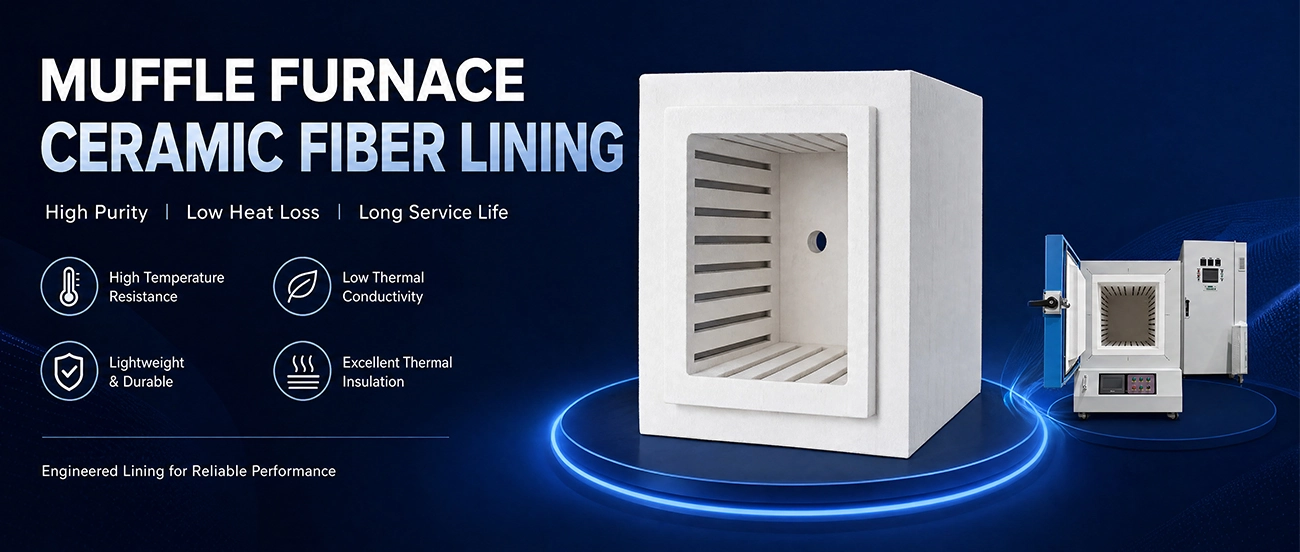
We manufacture and customize the complete family of ceramic fiber products used in chamber furnace construction. Most furnace linings combine several of these — a vacuum-formed hot-face chamber backed by board and blanket, for example — and we can supply the complete engineered package.
Our flagship product for muffle furnace manufacturers. Ceramic fiber slurry is vacuum-formed over precision tooling into a seamless, rigid, self-supporting chamber — walls, roof, and floor in one piece.
Key features:
Typical applications: benchtop muffle furnaces (1–2 L to 36 L+ chamber volumes), ashing furnaces, dental sintering furnaces, assay furnaces, small heat-treatment box furnaces.
Rigid, flat boards produced by vacuum forming, ideal for building larger box furnace chambers from panels, for door insulation, hearth support layers, and backup insulation behind vacuum-formed chambers.
The universal backup and wrap insulation. Needled double-sided blanket in 64–160 kg/m³ densities, 6–50 mm thicknesses, in 1260°C, 1360°C, and 1430°C grades. Used behind boards and formed chambers to build up total wall thickness economically, and for expansion joints, door seals, and casing insulation.
For large industrial box furnaces, car-bottom furnaces, and heat-treatment chambers, folded blanket modules with integral anchoring systems allow fast lining of big wall and roof areas. Pre-compressed modules expand after installation to form a tight, joint-free hot face.
Beyond chambers: burner blocks, peep-hole sleeves, thermocouple protection cones, tube seals, hearth plates, element carrier boards, dome and arch sections — any geometry your furnace design requires, formed or machined to tolerance.
Fiber paper (0.5–6 mm) for gasketing and expansion joints; rope, braid, and tape for door seals; rigidizer and surface coatings for extending lining life.
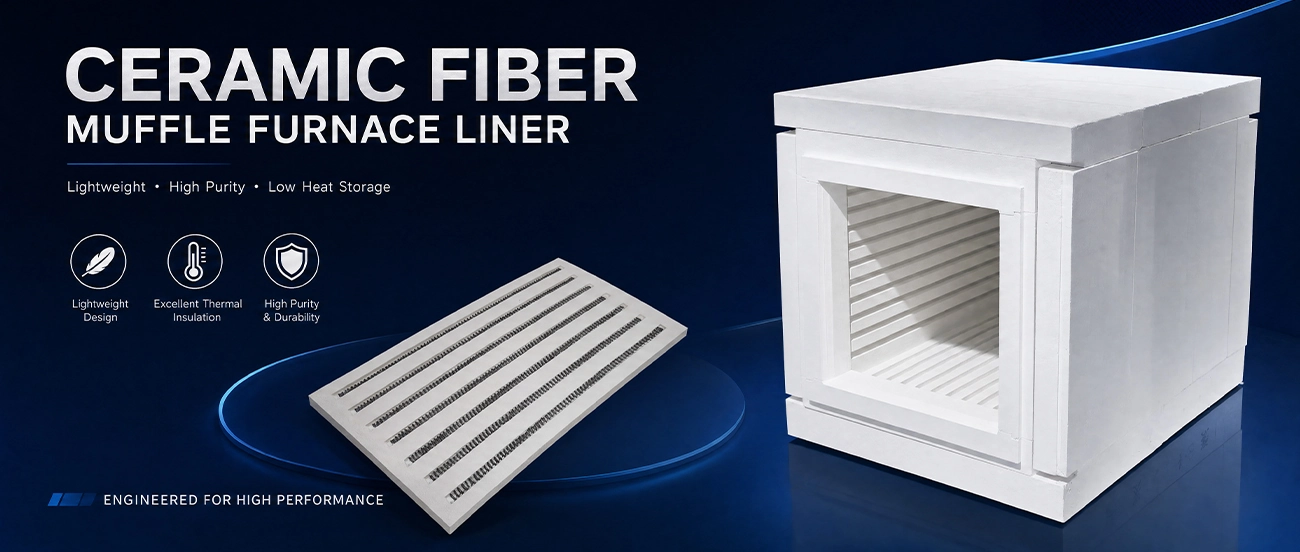
Off-the-shelf insulation forces furnace designers to compromise. We do the opposite — every dimension, groove, hole, and density is built to your specification. This is the core of our service to muffle furnace and box furnace manufacturers worldwide.
1. Chamber Geometry Any internal chamber size — from 100 × 100 × 100 mm benchtop muffles to 500 × 500 × 800 mm and larger industrial chambers. Rectangular, square, cylindrical, or stepped profiles. Wall thickness engineered to hit your target shell temperature.
2. Heating Element Integration
3. Ports and Openings Thermocouple holes at specified positions and diameters, exhaust/vent chimneys, gas inlet ports, view ports, over-temperature sensor holes — all formed or machined precisely, no field drilling required.
4. Density and Hardness Standard, high-density, and extra-hard vacuum-formed bodies; rigidized or coated hot faces for atmospheres with particulates or occasional contact.
5. Multi-Layer Lining Packages Complete kits: vacuum-formed hot face + board backup + blanket outer layer + fiber paper shell gasket, all cut to fit, delivered as a numbered set with an assembly drawing. Your production line installs a full furnace lining in minutes.
6. Doors, Hearths, and Accessories Vacuum-formed or board-laminated door plugs with sealing faces, high-strength hearth plates to carry crucibles and workloads, element carrier boards, and matching repair/spare parts for your after-sales program.
Low minimum order quantities make us practical for furnace rebuilders and R&D labs, not just OEMs — we regularly produce one-off replacement muffles for discontinued furnace models when customers send us the old chamber or its measurements.
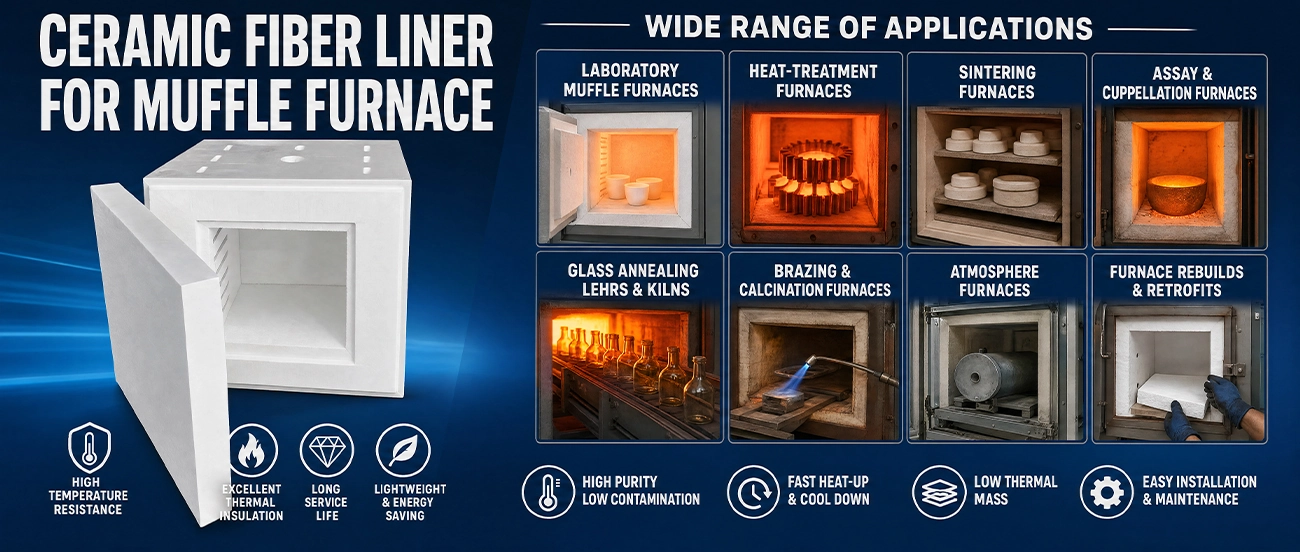
Furnace rebuilds and retrofits — replacing degraded brick or fiber linings in existing equipment
Laboratory muffle furnaces — ashing, loss-on-ignition, gravimetric analysis, sample preparation
Heat-treatment box furnaces — annealing, hardening, tempering, normalizing of steel and alloy parts
Sintering furnaces — technical ceramics, powder metallurgy, dental zirconia
Assay and cupellation furnaces — precious metals laboratories
Glass annealing lehrs and kilns — small-scale glass and enamel work
Brazing and calcination furnaces
Atmosphere and retort box furnaces — with appropriate grade selection for reducing atmospheres
| Ceramic Fiber Heating Module | XMF-1100 | XMF-1200 | XMF-1300 | XMF-1400 | XMF-1500 | XMF-1600 | |
| Working Temperature(℃) | 1100 | 1200 | 1350 | 1500 | 1600 | 1700 | |
| Density(kg/m³) | 300-600 | 300-600 | 300-600 | 300-600 | 450-700 | 450-700 | |
| Linear Shrinkage(24H) (After Burning) (%) | ≤3.0 (1100℃) | ≤3.0 (1250℃) | ≤3.0 (1300℃) | ≤1.0 (1450℃) | ≤1.0 (1550℃) | ≤1.0 (1650℃) | |
| Thermal Conductivty Rate (W/m.k) | 400℃ | 0.084 | 0.084 | 0.084 | / | / | / |
| 800℃ | 0.128 | 0.125 | 0.125 | 0.160 | 0.160 | 0.160 | |
| 1000℃ | 0.176 | 0.174 | 0.200 | 0.210 | 0.210 | 0.210 | |
| Heating Element | Resistance wire | SiC heating element | SiC heating element | MoSi2 heating element | MoSi2 heating element | MoSi2 heating element | |
| Furnace Chamber Size | Customized | Customized | Customized | Customized | Customized | Customized | |
| The sizes and packaging can be customized according to your needs | |||||||
Detailed disassembly video
Yes. Send us the old chamber, photos with measurements, or the furnace model number. We reverse-engineer replacement muffles for most common laboratory furnace brands, including element groove layouts.
A one-piece vacuum-formed chamber has no joints — better thermal uniformity, faster assembly, and superior element support, ideal up to roughly 40 L chamber volumes. Board-assembled construction is more economical for larger industrial chambers and easier to repair panel-by-panel. We supply both and will recommend based on your size and budget.
In clean, cyclic laboratory service, vacuum-formed chambers commonly last 3–5+ years. Life depends on peak temperature vs. grade, atmosphere (fluxes, alkalis, and water vapor accelerate degradation), and mechanical handling. Correct grade selection is the biggest factor — we help you get it right.
Yes. Low MOQ, and existing tooling covers many common muffle sizes, meaning small orders often need no tooling charge at all.
Yes. Many OEM customers buy fully integrated chambers with FeCrAl coils installed and lead-outs positioned to their wiring drawing, cutting their assembly time dramatically.
 ceramicfiber

提交产品咨询
我们将会在24小时内联系您