Search the whole station
Industrial furnaces, kilns, and high-temperature process heaters are among the most energy-intensive assets in heavy industry. Whether producing steel, cement, glass, petrochemicals, ceramics, or nonferrous metals, the furnace lining sits at the center of a constant balancing act: it must contain extreme heat, protect the structural shell, survive years of thermal cycling and chemical attack, and do all of this while minimizing the energy lost through the furnace wall — because every unit of heat that escapes through poor insulation is fuel or electricity paid for and never converted into product.
For decades, dense refractory brick and castable linings were the default choice for industrial furnace construction. But as energy costs have risen and industries have come under growing pressure to reduce carbon emissions and improve process efficiency, ceramic fiber insulation has moved from a specialty material into a mainstream solution for lining, backup insulation, and full furnace hot-face construction across a wide range of industrial furnace types.
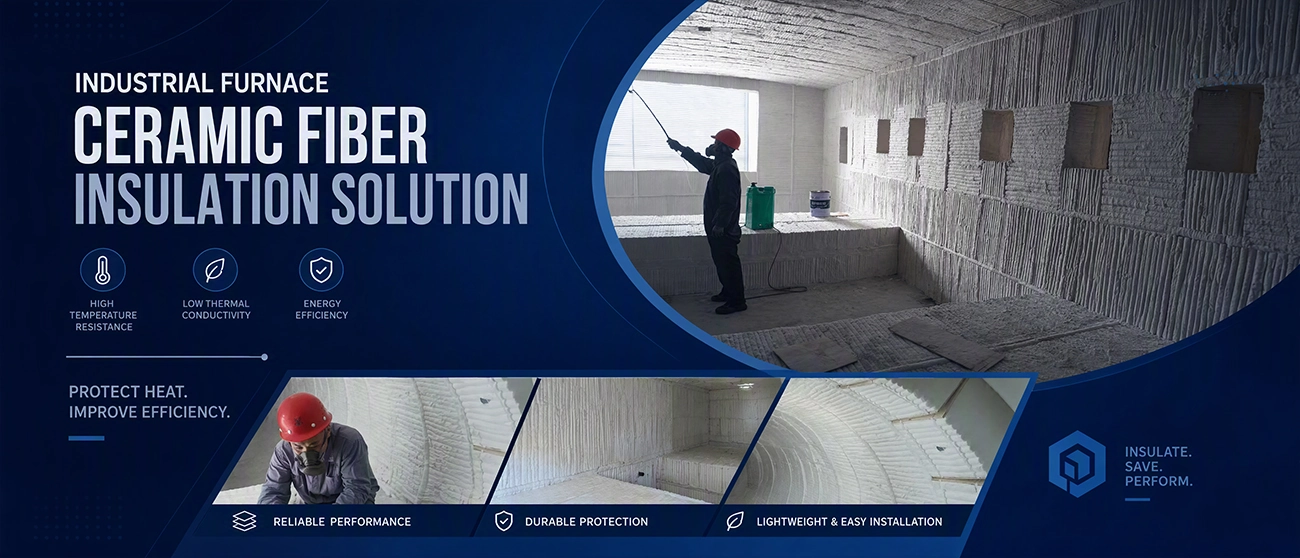
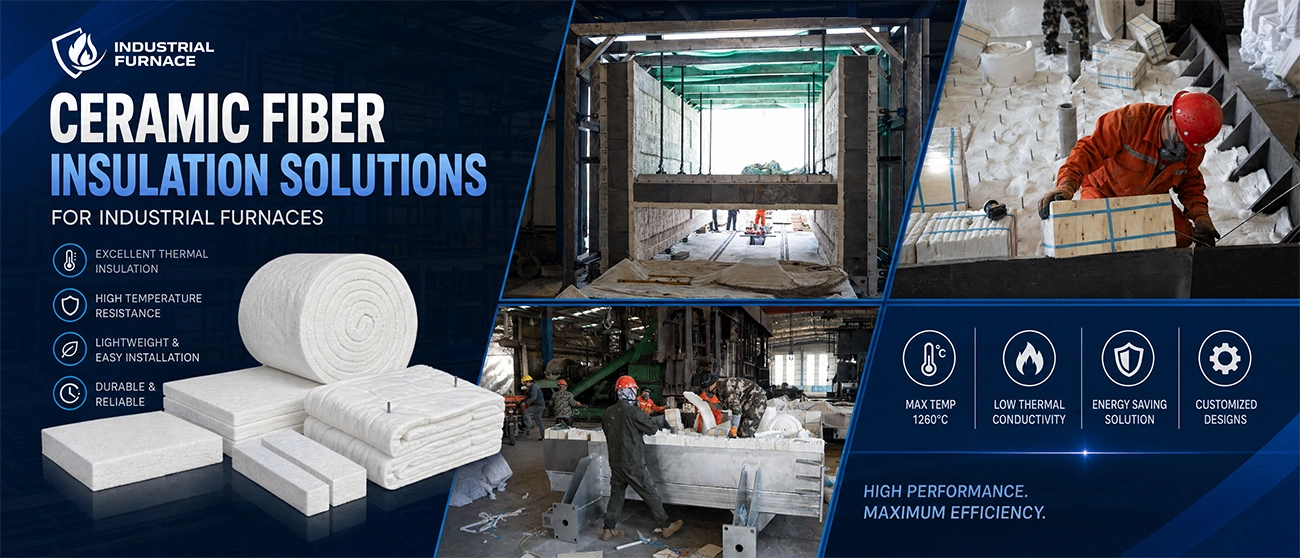
Ceramic fiber (also called refractory ceramic fiber, or RCF) is a family of lightweight, fibrous refractory materials produced by melting raw materials — primarily alumina and silica, sometimes with zirconia or other additives — and spinning or blowing the melt into fine fibers. These fibers are then processed into a range of product forms suited to different furnace construction and lining needs:
Ceramic fiber products are available in a range of classification temperatures — commonly 1260°C, 1400°C, and 1600°C+ grades — allowing engineers to match fiber chemistry and product form to the specific thermal demands of each furnace zone.
Dense fireclay or high-alumina brick, and castable refractory concrete, remain widely used in industrial furnace construction, particularly where high mechanical wear resistance or direct flame/slag contact is involved. However, for pure insulating performance, ceramic fiber offers fundamental advantages rooted in its physical structure:
These properties translate into measurable, well-documented benefits across nearly every category of industrial furnace.
Dense fireclay or high-alumina brick, and castable refractory concrete, remain widely used in industrial furnace construction, particularly where high mechanical wear resistance or direct flame/slag contact is involved. However, for pure insulating performance, ceramic fiber offers fundamental advantages rooted in its physical structure:
These properties translate into measurable, well-documented benefits across nearly every category of industrial furnace.
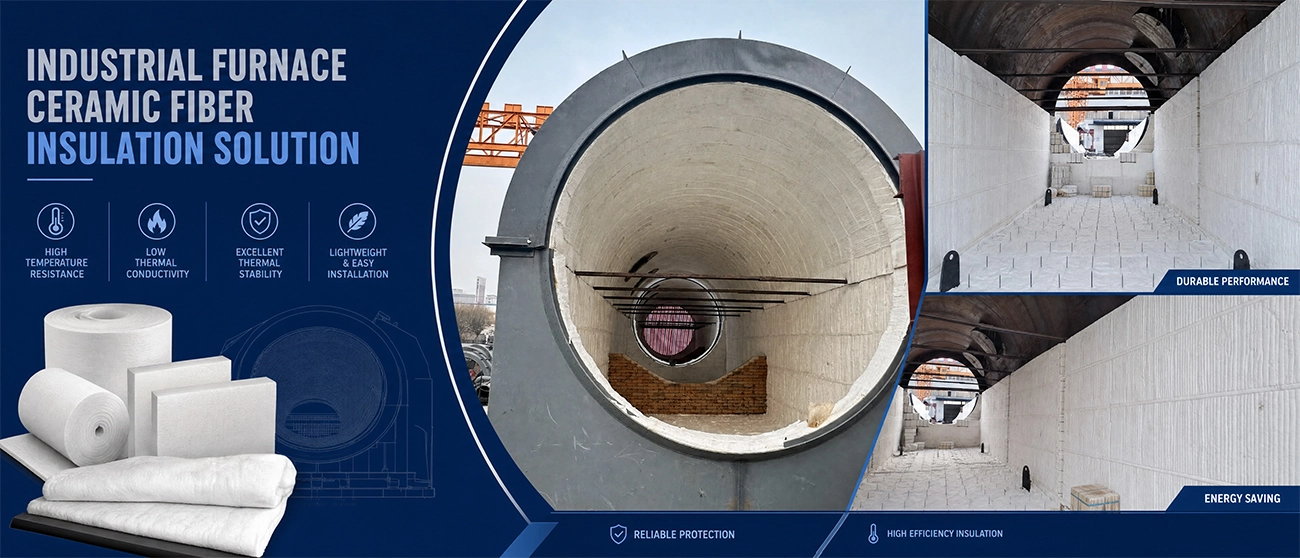
Because ceramic fiber’s low thermal conductivity reduces heat loss through the furnace shell, and its low thermal mass reduces the energy consumed in heating the lining itself during each cycle, furnaces relined with ceramic fiber — or designed with ceramic fiber from the outset — commonly achieve substantial fuel or electricity savings compared to equivalent brick or castable construction, particularly in furnaces that operate with frequent start-stop or batch cycling rather than continuous steady-state operation.
Lower thermal mass means furnaces reach operating temperature faster after startup and cool down faster for maintenance access or product changeover. In batch-type industrial furnaces — such as heat treatment furnaces processing different part loads throughout a shift — this translates directly into improved throughput and production scheduling flexibility.
Because ceramic fiber is dramatically lighter than dense refractory, furnace designers can reduce the structural steel and foundation requirements needed to support the lining, or use the weight savings to enable larger furnace volumes within existing structural limits — an important consideration in furnace upgrade and revamp projects where structural capacity is fixed.
Industrial processes involving frequent thermal cycling — batch heat treatment, intermittent kiln operation, furnaces subject to unplanned shutdowns — benefit from ceramic fiber’s resistance to the cracking, spalling, and joint failure that progressively degrades brick and castable linings under repeated thermal stress.
Modular ceramic fiber systems (module and prefabricated board sections) can be installed significantly faster than brick masonry or cast-in-place castable, which requires curing time before the furnace can be fired. This reduces furnace outage duration during new construction, relining, and repair projects — a critical factor in industries where furnace downtime carries substantial production cost.
Specialized ceramic fiber formulations are available with enhanced resistance to specific chemical environments — such as alkali attack in cement kilns, sulfur compounds in petrochemical heaters, or reducing atmospheres in metal processing — allowing the lining to be tailored to the specific chemical exposure of each furnace application.
Properly designed ceramic fiber lining systems reduce the outer furnace shell temperature, improving workplace safety around the furnace, reducing radiant heat load in the surrounding work area, and in many cases eliminating the need for additional external insulation cladding.
Batch and continuous heat treatment furnaces — used for annealing, normalizing, hardening, tempering, and stress relieving of steel and other metal components — are one of the largest application areas for ceramic fiber lining. The frequent thermal cycling inherent to batch heat treatment operations makes ceramic fiber’s low thermal mass and thermal shock resistance particularly valuable, both for energy savings and for extending lining service life compared to castable alternatives.
Walking beam and pusher-type reheating furnaces, used to bring steel billets and slabs to forging or rolling temperature, increasingly incorporate ceramic fiber module linings in furnace walls and roofs to reduce heat loss and structural loading, often in combination with wear-resistant castable or brick in high-abrasion floor and hearth zones.
Aluminum industry furnaces benefit from ceramic fiber’s fast thermal response for melt cycle optimization, along with formulations resistant to aluminum vapor and flux attack in the furnace superstructure and roof areas.
While rotary kiln hot zones typically require abrasion-resistant brick or castable due to direct contact with the moving material bed, ceramic fiber is widely used in kiln backup insulation, kiln hoods, transition zones, coolers, and preheater tower ductwork, where its light weight and insulating efficiency reduce shell temperature and energy loss across large surface areas.
Fired heaters, reformers, and cracking furnaces in the petrochemical and refining industries widely use ceramic fiber module linings for furnace walls, roofs, and convection sections, valued for light weight (reducing structural steel requirements on large heaters), fast heat-up during startup, and long-term energy savings across continuous, high-temperature operation.
Glass furnace superstructures, regenerator chambers, and forming section equipment use ceramic fiber insulation to manage the extreme, sustained temperatures of glass melting while minimizing structural heat loss — particularly valuable given the continuous, 24/7 operating cycles typical of glass manufacturing, where even small efficiency gains compound significantly over a multi-year furnace campaign.
Tunnel kilns, shuttle kilns, and periodic kilns used in ceramics, tile, sanitaryware, and refractory brick manufacturing use ceramic fiber module and board linings extensively, particularly in shuttle and periodic kilns where frequent thermal cycling between firing batches makes low thermal mass lining essential for energy efficiency and cycle time.
Industrial and hazardous waste incinerators, along with thermal and catalytic oxidizers used for air pollution control, use ceramic fiber lining for its combination of high-temperature capability, thermal shock resistance (important given variable waste feed and combustion conditions), and light weight relative to traditional castable incinerator linings.
Copper, zinc, lead, and other nonferrous smelting furnaces, along with foundry melting and holding furnaces, use ceramic fiber in furnace superstructures, roofs, and backup insulation zones, often paired with more chemically resistant brick or castable in areas of direct molten metal or slag contact.
High-temperature ductwork, expansion joints, boiler casings, and flue gas system components in power generation facilities use ceramic fiber blanket and module systems for insulation and sealing, valued for flexibility around complex geometries and long-term thermal stability.
Calcining and graphitizing furnaces used in carbon and graphite product manufacturing rely on ceramic fiber’s high-temperature stability and low thermal conductivity to manage the extreme temperatures involved while controlling energy consumption across long production campaigns.
Beyond fired heaters, various chemical process reactors and vessels operating at elevated temperature use ceramic fiber external and internal insulation to manage process heat loss and protect personnel and structural components from high surface temperatures.
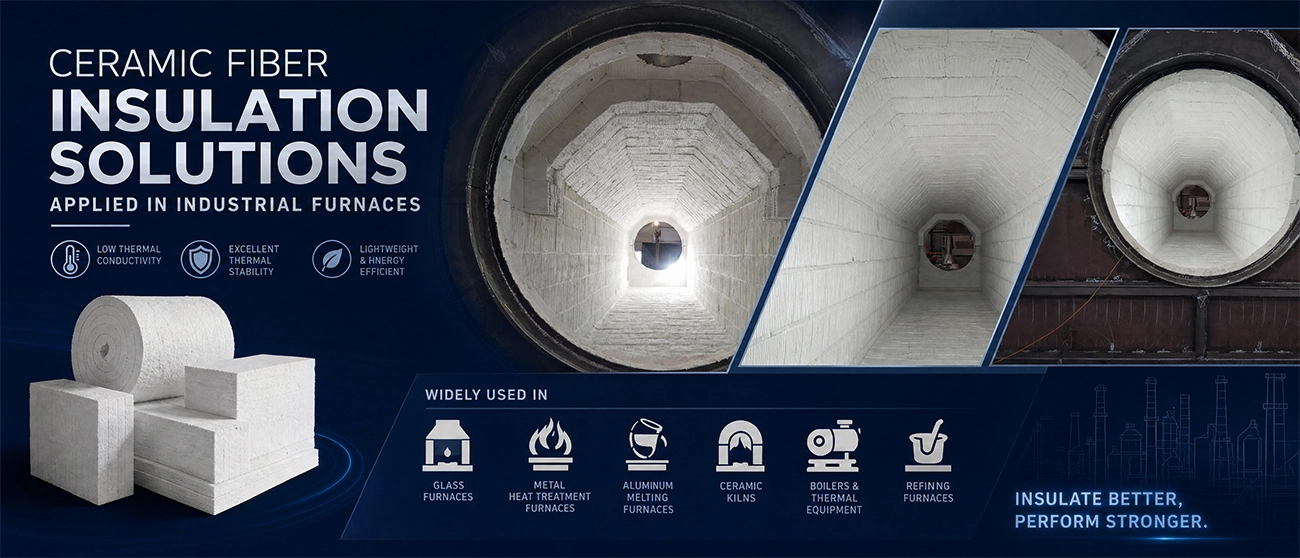
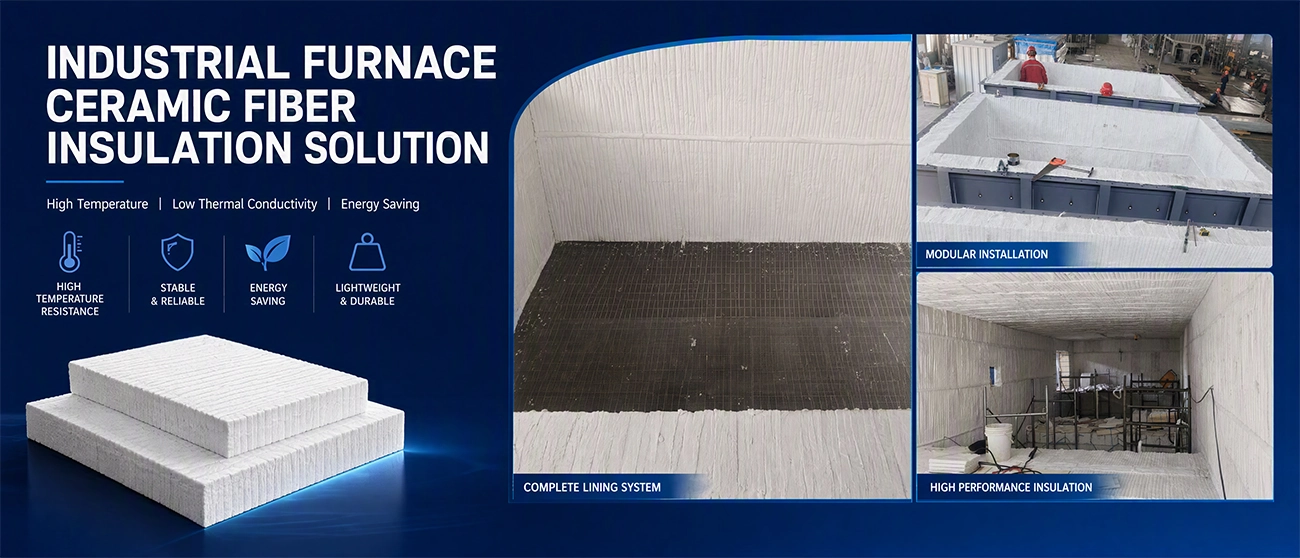
Ceramic fiber modules — factory-compressed blocks of folded blanket, fitted with internal anchoring hardware — are the dominant lining system for large industrial furnace walls and roofs. Modules are installed side by side directly onto the furnace shell (with appropriate anchoring studs), providing a dense, uniform, gap-minimized lining that installs significantly faster than brick masonry while delivering excellent insulating performance across large surface areas typical of reheating furnaces, petrochemical heaters, and kiln structures.
In applications requiring a more mechanically robust hot-face surface — such as areas subject to mechanical contact, higher gas velocities, or particulate erosion — a layered system combining a rigid ceramic fiber board or vacuum-formed hot-face layer with lower-cost blanket or module backup insulation optimizes both durability and cost across the thermal gradient through the wall.
Many industrial furnaces use ceramic fiber in combination with traditional dense refractory — for example, an abrasion-resistant castable or brick hot-face layer in zones of direct flame impingement, mechanical wear, or chemical attack, backed by a ceramic fiber insulating layer that handles the bulk of the thermal insulation function. This hybrid approach captures the durability of dense refractory where it’s structurally necessary while using ceramic fiber’s superior insulating efficiency everywhere else.
Ceramic fiber rope, tape, cloth, and paper products are used throughout industrial furnace construction for door seals, expansion joints between refractory sections, burner block sealing, and protective wrapping of thermocouples, cables, and other components penetrating the hot zone — applications where flexibility and gap-sealing performance are as important as raw insulating value.
Thin, dense ceramic fiber paper products provide high-temperature gasketing and sealing in flange connections, expansion joints, and other precision-fit applications where a thin, conformable, high-temperature-stable material is required.
Select fiber grade based on the maximum continuous operating temperature of each furnace zone, with appropriate safety margin:
Higher-density ceramic fiber products (module and board) offer improved mechanical stability, better resistance to erosion from high gas velocities, and marginally improved insulating performance per unit thickness — but at greater material cost and weight. Furnace designers typically select density based on the specific mechanical and thermal demands of each lining zone rather than using a single density throughout the furnace.
Linear shrinkage ratings after extended exposure at classification temperature indicate how well the lining will maintain its insulating thickness and structural fit over years of service — an important factor in total lifecycle cost, since excessive shrinkage leads to gaps, hot spots, and premature relining.
Furnace atmosphere and process chemistry should inform fiber and binder selection — alkali-resistant formulations for cement and lime kilns, sulfur-resistant grades for certain petrochemical applications, and formulations suited to reducing or oxidizing atmospheres depending on the specific process.
Module and board anchoring systems must be engineered for the specific furnace geometry, orientation (wall, roof, floor), and any vibration or mechanical loading the lining will experience, using anchor materials (metallic or ceramic) rated for the local temperature at the anchor point.
 ceramicfiber

提交产品咨询
我们将会在24小时内联系您