Search the whole station
A ceramic fiber gasket is a high-temperature sealing component made from ceramic fiber materials such as ceramic fiber paper, ceramic fiber blanket, ceramic fiber board, ceramic fiber cloth, or ceramic fiber tape. It is designed to provide reliable sealing, insulation, and thermal protection in equipment exposed to extreme heat, flame, hot gases, and repeated thermal cycling.
In industrial furnaces, kilns, boilers, ovens, heaters, exhaust systems, and petrochemical equipment, ordinary rubber, plastic, or organic gaskets cannot survive high operating temperatures. Ceramic fiber gaskets solve this problem by offering excellent heat resistance, low thermal conductivity, good compressibility, and strong resistance to thermal shock.
For engineers, maintenance teams, OEM manufacturers, and purchasing managers, ceramic fiber gaskets are practical because they can be customized into different shapes, thicknesses, densities, and temperature grades. They can be die-cut, waterjet-cut, stamped, layered, or fabricated according to drawings, making them suitable for both standard equipment and custom high-temperature systems.
This guide explains what ceramic fiber gaskets are, how they work, their key properties, common applications, advantages, material options, selection factors, installation tips, and supplier considerations.
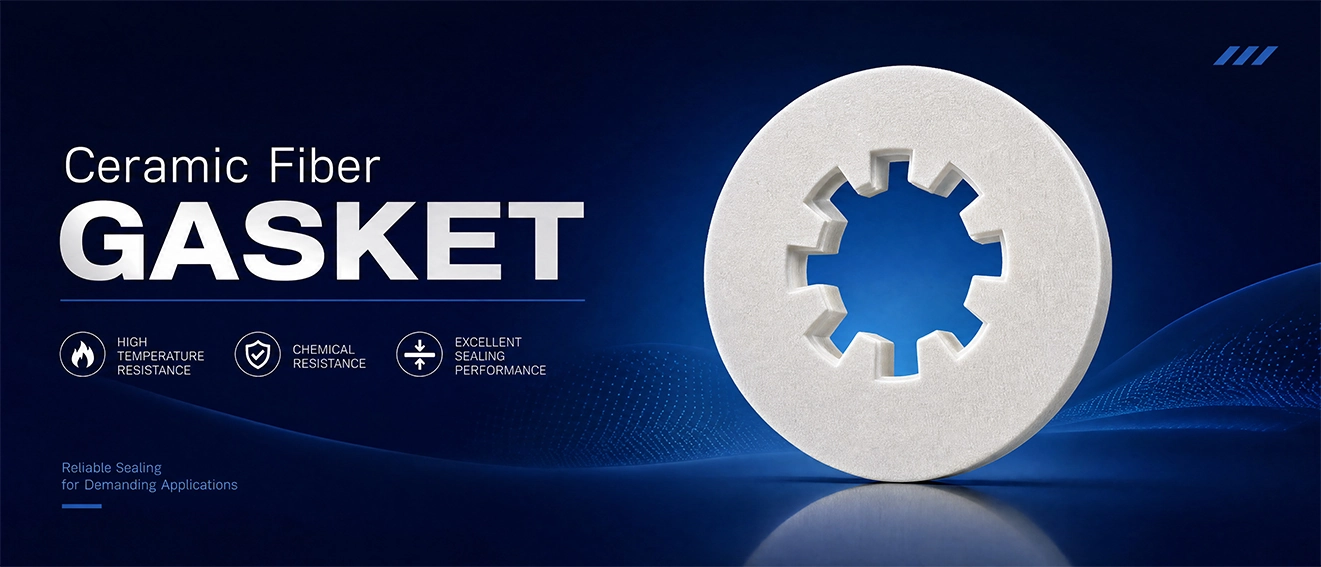
A ceramic fiber gasket is a gasket made from ceramic fiber insulation material. Ceramic fibers are usually based on alumina and silica, giving them strong resistance to high temperatures. These fibers are processed into different forms, and then cut or fabricated into gasket shapes for sealing and insulation.
Unlike traditional gaskets made from rubber, cork, graphite, PTFE, or non-asbestos compressed sheet, ceramic fiber gaskets are designed primarily for thermal resistance rather than liquid sealing under high pressure. They are commonly used to seal hot air, flue gas, furnace doors, kiln access panels, inspection ports, boiler covers, burner blocks, expansion joints, and other high-temperature joints.
A ceramic fiber gasket can be soft and compressible or more rigid, depending on the base material. For example, ceramic fiber paper gaskets are thin, smooth, and flexible. Ceramic fiber blanket gaskets are thicker and more compressible. Ceramic fiber board gaskets are rigid and dimensionally stable. Ceramic fiber cloth or tape gaskets offer woven strength and flexibility.
Because ceramic fiber gaskets can be customized, they are widely used in industrial maintenance, equipment manufacturing, and thermal engineering projects.
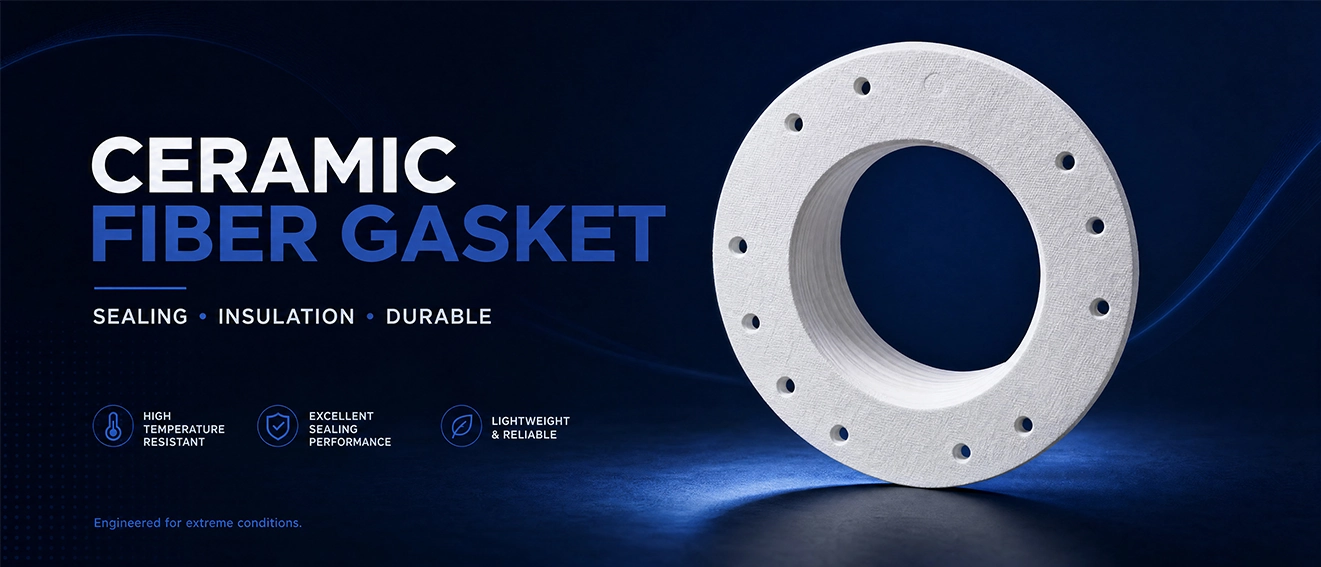
High-temperature equipment often has joints, doors, flanges, covers, and inspection openings. If these areas are not sealed properly, heat can escape, hot gases can leak, energy efficiency can decrease, and nearby components may suffer thermal damage.
A ceramic fiber gasket helps reduce these problems by filling gaps and creating a thermal barrier. It helps keep heat inside the process, improves temperature stability, and protects surrounding structures. In many cases, a properly selected ceramic fiber gasket can reduce heat loss, improve equipment efficiency, and extend service life.
Ceramic fiber gaskets are especially useful where equipment experiences repeated heating and cooling cycles. Dense refractory materials may crack under thermal shock, while many traditional gasket materials lose strength or burn out. Ceramic fiber materials can tolerate rapid temperature changes and remain effective in demanding conditions.
Ceramic fiber gaskets are valued because they combine high temperature resistance with flexibility and insulation performance. Their main properties include heat resistance, low thermal conductivity, low heat storage, compressibility, chemical stability, lightweight construction, and easy fabrication.
The most important property is high temperature resistance. Depending on the material type and grade, ceramic fiber gaskets can be used in applications reaching approximately 1000°C, 1260°C, or higher classification temperatures. The actual continuous working temperature depends on fiber composition, density, atmosphere, mechanical load, and exposure time.
Low thermal conductivity is another major advantage. Ceramic fiber gaskets help reduce heat transfer through joints and surfaces. This improves insulation performance and helps lower energy loss.
Compressibility is important for sealing. A ceramic fiber gasket can adapt to uneven surfaces and fill small gaps between metal or refractory components. This is useful for furnace doors, access panels, and expansion joints where surfaces may not be perfectly flat.
Thermal shock resistance allows ceramic fiber gaskets to withstand repeated heating and cooling cycles. This is valuable in equipment that starts and stops frequently.
Ceramic fiber gaskets are also lightweight. Compared with dense refractory gaskets or cast components, they add very little weight to equipment. This can simplify installation and maintenance.
Ceramic fiber gaskets are used across many high-temperature industries. One of the most common applications is furnace door sealing. Furnace doors must be opened and closed regularly, and the seal must resist heat, compression, and thermal cycling. Ceramic fiber gaskets help prevent heat loss and hot gas leakage.
In kilns, ceramic fiber gaskets are used around doors, inspection ports, kiln cars, and removable panels. They improve temperature control and protect the surrounding structure.
In boilers and heaters, ceramic fiber gaskets are used on access doors, burner assemblies, flanges, and covers. They help seal hot gas paths and reduce heat transfer.
In exhaust systems, ceramic fiber gaskets provide thermal insulation and sealing around hot joints. They may be used in automotive, marine, power generation, and industrial exhaust equipment.
In petrochemical plants, ceramic fiber gaskets are used in process heaters, reformers, flue ducts, expansion joints, and high-temperature piping systems.
In appliance manufacturing, ceramic fiber gaskets are found in ovens, fireplaces, stoves, heaters, and other equipment requiring heat-resistant sealing.
Ceramic fiber gaskets are also used in glass manufacturing, steel plants, foundries, aluminum processing, ceramics production, power plants, aerospace systems, and fire protection equipment.
Ceramic fiber gaskets can be made from several ceramic fiber product forms. Each material has different strengths, so the best choice depends on the application.
Ceramic fiber paper is one of the most common materials for thin gaskets. It has a smooth surface, uniform thickness, and good flexibility. Ceramic fiber paper gaskets are often used for flange insulation, appliance seals, burner gaskets, heat shields, and precision die-cut parts.
Ceramic fiber blanket is used when a thicker and more compressible gasket is needed. It is suitable for furnace doors, kiln cars, expansion gaps, and large sealing areas. Blanket gaskets provide excellent insulation and cushioning.
Ceramic fiber board is selected when rigidity and shape stability are required. Board gaskets are useful for structural insulation, high-temperature panels, furnace linings, and applications where the gasket must maintain a firm profile.
Ceramic fiber cloth and tape are woven textile materials. They are often used for flexible seals, wrapping, door strips, and gasket layers that require higher tensile strength. Some woven ceramic fiber products are reinforced with fiberglass filament or stainless steel wire.
Ceramic fiber rope can also be used as a gasket material, especially for furnace door channels, round grooves, and expansion joints. Rope gaskets are available in round, square, twisted, and braided forms.
Ceramic fiber paper gaskets are thin, lightweight, and easy to cut. They are commonly used in applications where space is limited and a precise gasket shape is required. Because ceramic fiber paper has a smooth surface and consistent thickness, it is suitable for die-cutting into washers, rings, strips, pads, and complex profiles.
These gaskets are often used in heaters, ovens, boilers, exhaust equipment, electrical appliances, and industrial thermal systems. They provide excellent heat insulation and separation between hot surfaces.
Ceramic fiber paper usually contains a small amount of organic binder to improve handling strength. During first heating, the binder burns out. This may produce smoke or odor, so proper ventilation is recommended.
Ceramic fiber blanket gaskets are thicker and softer than paper gaskets. They are useful when the joint has a larger gap or when greater compression is required. Furnace doors, kiln doors, boiler access covers, and thermal expansion joints often benefit from blanket-based gaskets.
Because ceramic fiber blanket has very low thermal conductivity and low heat storage, it helps reduce heat loss in large high-temperature openings. It can also absorb movement caused by thermal expansion.
However, blanket gaskets may be less precise than paper or board gaskets. For applications requiring accurate shapes or tight tolerances, ceramic fiber paper or board may be more suitable.
Ceramic fiber board gaskets offer better rigidity and mechanical stability. They are made from ceramic fibers with binders and are formed into firm boards. These boards can be cut into gasket shapes for high-temperature insulation and sealing.
Board gaskets are useful where the gasket must keep its shape under light pressure or where a flat, stable insulation barrier is required. They are often used in furnace structures, burner blocks, industrial ovens, and thermal equipment panels.
Compared with paper or blanket, ceramic fiber board is less flexible. It is not ideal for curved surfaces or joints that require high compression, but it performs well in flat and stable assemblies.
Ceramic fiber gaskets offer several practical benefits. The first is excellent heat resistance. They can operate in high-temperature environments where ordinary gasket materials would degrade, melt, harden, or burn.
The second benefit is insulation performance. Ceramic fiber gaskets reduce heat transfer and help improve energy efficiency. This is especially important in furnaces, kilns, boilers, and ovens where heat loss directly increases operating cost.
The third benefit is compressibility. Many ceramic fiber gaskets can fill uneven gaps and provide effective sealing under moderate compression.
The fourth benefit is customization. Ceramic fiber materials can be cut into many shapes, including rings, strips, washers, pads, frames, and complex parts based on drawings.
The fifth benefit is thermal shock resistance. Ceramic fiber gaskets can handle repeated heating and cooling cycles better than many rigid refractory materials.
The sixth benefit is lightweight construction. This makes installation easier and reduces the load on equipment components.
The seventh benefit is versatility. A ceramic fiber gasket can serve as a seal, insulation pad, thermal barrier, spacer, expansion joint filler, or protective layer.
Traditional gasket materials such as rubber, cork, PTFE, and standard fiber sheets are useful in many sealing applications, but they are not designed for extreme heat. Rubber gaskets may burn or harden. PTFE has a limited high-temperature range. Organic fiber gaskets can lose strength or carbonize.
Ceramic fiber gaskets are different because they are designed for high-temperature thermal sealing. They are not usually selected for high-pressure liquid sealing, but they are excellent for hot air, hot gas, furnace, kiln, boiler, and thermal insulation applications.
Compared with graphite gaskets, ceramic fiber gaskets usually offer better insulation and lower weight, while graphite may be better for certain pressure sealing applications. Compared with metal gaskets, ceramic fiber gaskets are softer and more insulating, but they do not provide the same pressure resistance.
The right gasket depends on the sealing medium, temperature, pressure, compression load, surface condition, and safety requirements.
Ceramic fiber gaskets are available in different temperature grades. Standard alumina-silica ceramic fiber products are often rated around 1260°C classification temperature. Higher-grade materials may be used for more demanding conditions.
However, buyers should not choose a gasket based only on maximum classification temperature. Continuous service temperature is often lower than the classification rating. Real performance depends on atmosphere, mechanical pressure, chemical exposure, gas velocity, vibration, and heating cycle frequency.
For example, a ceramic fiber gasket used in a static oven door may last longer than the same gasket used in a vibrating exhaust joint with high gas velocity. A gasket exposed to corrosive gases may require special material evaluation.
Always check the supplier’s technical data sheet before selecting a product. Important data may include chemical composition, classification temperature, density, thickness, tensile strength, shrinkage, thermal conductivity, and loss on ignition.
Many ceramic fiber gaskets are custom-made. Manufacturers can cut ceramic fiber paper, blanket, board, cloth, or tape into required shapes based on drawings or samples.
Common custom forms include round gaskets, square gaskets, rectangular frames, flange gaskets, burner gaskets, strips, washers, insulation pads, door seals, and complex die-cut components.
Custom ceramic fiber gaskets are especially useful for OEM manufacturers because they improve consistency and reduce assembly time. Instead of cutting insulation material manually, workers can install pre-cut parts that match the equipment design.
When ordering custom ceramic fiber gaskets, provide the following details: material type, operating temperature, thickness, density, dimensions, tolerance, drawing file, quantity, application environment, and packaging requirements.
For critical equipment, sample testing is recommended before mass production.
Grade | Common | Standard | Zirconium | |
Classification Temperature (ºC) | 1150 | 1260 | 1450 | |
Shrinkage on heating (%) | 800°Cx24h≤-3 | 1000°Cx24h≤-3 | 1280°Cx24h≤-3 | |
Thermal conductivity by mean temp. (w/m.k) (200kg/m3) | 200ºC | 0.055~0.065 | 0.055~0.065 | 0.060~0.070 |
400ºC | 0.110~0.120 | 0.110~0.120 | 0.105~0.125 | |
600ºC | 0.160~0.170 | 0.160~0.170 | 0.170~0.180 | |
Density (Kg/m3) | 30~450kg/m | |||
| Size (mm) | According to customers’need and drawings | |||
Get Started Free Call?
TEL: +86 1234567
E-mail: info@xxx.com
Detailed disassembly video
A ceramic fiber gasket is used for high-temperature sealing, insulation, gasketing, and thermal protection. Common applications include furnaces, kilns, boilers, ovens, heaters, exhaust systems, and industrial access doors.
Ceramic fiber gaskets are mainly used for thermal insulation and hot gas sealing. They are usually not the best choice for high-pressure liquid sealing unless combined with other materials or designed specifically for that purpose.
Yes. Ceramic fiber gaskets can be cut into custom shapes, sizes, thicknesses, and profiles. Common custom products include flange gaskets, door seals, strips, pads, washers, and insulation frames.
Some are flexible, especially those made from ceramic fiber paper, blanket, cloth, tape, or rope. Ceramic fiber board gaskets are more rigid.
Some ceramic fiber materials contain organic binders to improve handling strength. These binders may burn out during initial heating.
 ceramicfiber

提交产品咨询
我们将会在24小时内联系您