 ceramicfiber
What Temperature Can Ceramic Fiber Withstand?
1289Comparing ceramic fiber filter tubes and fabric bag filters for high-temperature dust removal — temperature limits, efficiency, cost, and which fits your process.
View detailsSearch the whole station
If your facility is evaluating dust collection equipment for a high-temperature process — a boiler, sintering line, cement kiln, or waste incinerator — you’ve likely come across two very different filtration technologies: traditional fabric bag filters (baghouses) and ceramic fiber filter tubes (also called ceramic filter candles). Both remove particulate from flue gas, but they work in fundamentally different ways, and that difference has real consequences for temperature tolerance, maintenance, emission performance, and total cost of ownership.
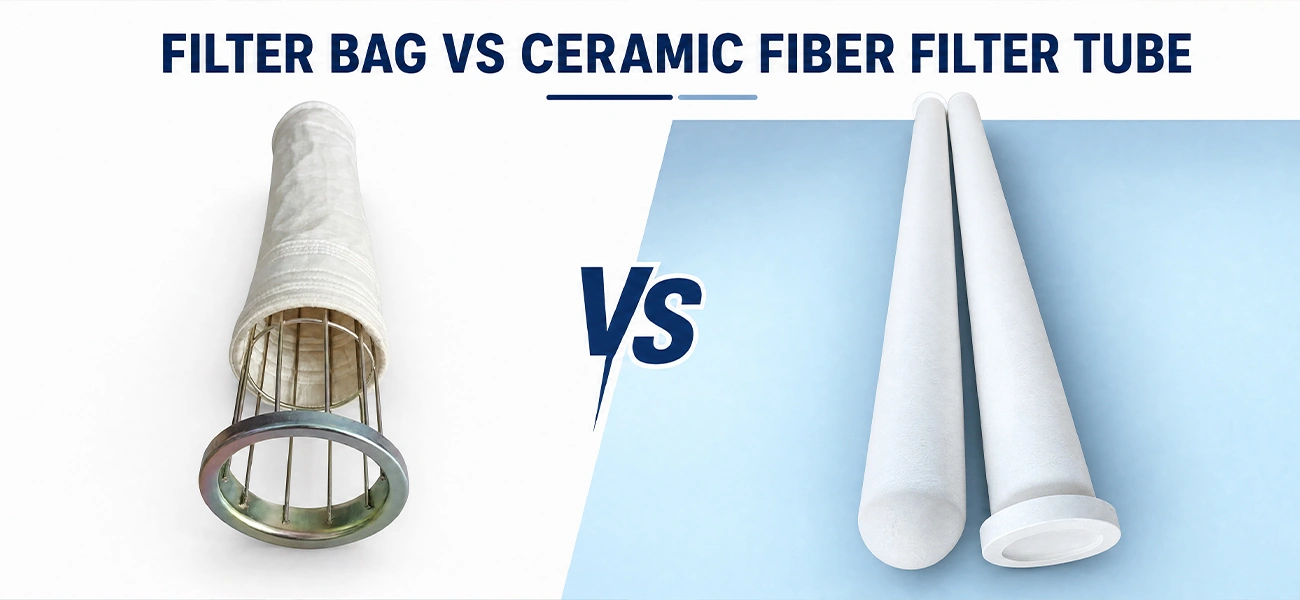
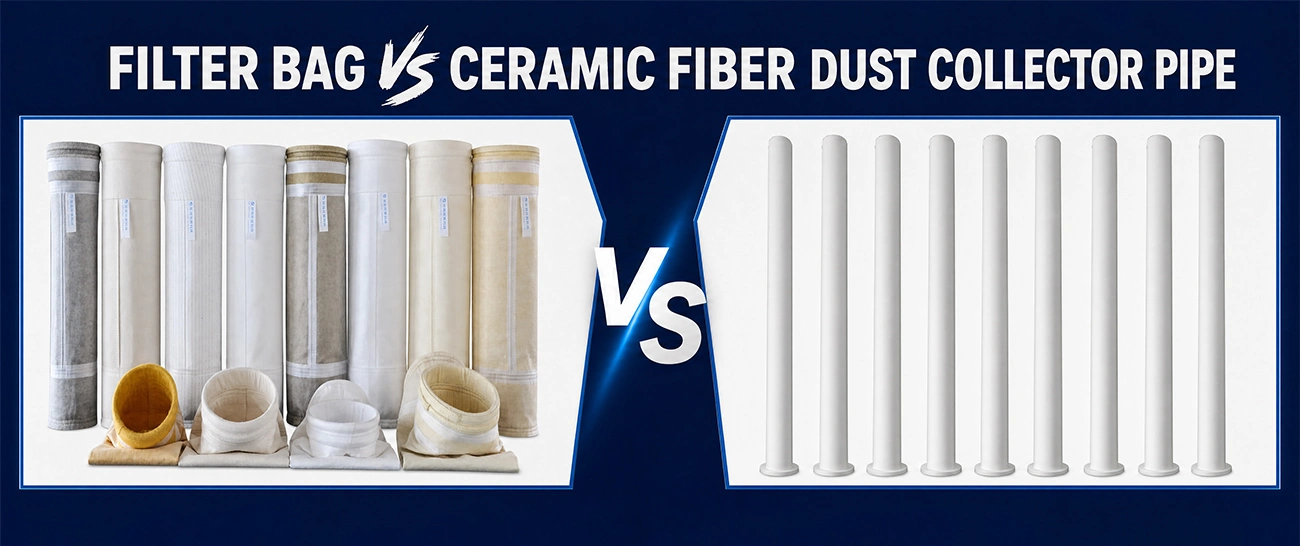
Fabric bag filters use flexible filter bags — woven or felted from materials like polyester, PTFE, PPS (Ryton), or aramid — hung inside a housing and supported internally by a metal cage. Dust-laden gas passes through the fabric, particulate collects on the surface (and to some degree within the fabric structure), and periodic pulse-jet cleaning knocks the accumulated dust cake loose so it falls into a hopper below.
Ceramic fiber filter tubes are rigid, self-supporting cylindrical elements made from bonded refractory ceramic fibers — typically alumina-silicate or mullite-based. They don’t need an internal support cage because the tube holds its own shape. Filtration happens on the tube’s outer surface, and pulse-jet cleaning works similarly to a baghouse, dislodging the dust cake without damaging the rigid structure.
At a glance, the cleaning mechanism looks similar. The real differences show up in temperature tolerance, material behavior over time, and what each technology can do beyond simple particulate capture.conductivity compared with many traditional refractory materials, it can significantly reduce the weight of furnace linings while providing effective thermal insulation.
This is usually the deciding factor before any other comparison even matters.
| Fabric Type | Typical Continuous Temperature Limit |
|---|---|
| Polyester | ~130-150°C |
| Aramid (Nomex) | ~200-204°C |
| PPS (Ryton) | ~190°C |
| PTFE | ~250-260°C |
| Fiberglass | ~260°C |
| Ceramic fiber tube | 350-900°C+ (grade dependent) |
If your process gas runs above roughly 260°C — which is common in boiler exhaust, sintering off-gas, kiln tail gas, and incinerator flue gas — fabric filters simply aren’t an option without first cooling the gas stream. That cooling step (via dilution air, heat exchange, or a spray tower) adds equipment, adds a source of thermal energy waste, and in the case of dilution air, increases the total gas volume the filter system has to handle.
Ceramic fiber tubes can often be installed directly downstream of the process outlet, before any cooling stage, which removes that energy penalty entirely and simplifies the overall gas path.
Both technologies can achieve very high particulate removal efficiency — often 99.9%+ under proper design conditions, with outlet concentrations in the single-digit mg/Nm³ range achievable by well-designed systems of either type.
Where they diverge is in how that performance holds up over the equipment’s service life:
Ceramic fiber tubes, being rigid with a denser, more uniform pore structure, resist this deep penetration more effectively, tending to hold more stable pressure drop and filtration performance across a longer service interval — commonly 3-5+ years versus the 1.5-3 year bag replacement cycle typical in demanding high-temperature, high-corrosivity service.
Fabric bags are prone to gradual depth loading — fine particles penetrate into the fabric structure over time rather than staying on the surface, which increases pressure drop and can reduce cleaning effectiveness as the bag ages. Repeated thermal cycling near a fabric’s upper temperature limit also accelerates fiber embrittlement and shrinkage.
This is where the two technologies diverge most sharply for many industrial applications. A standard fabric baghouse does one job: capture particulate. Some advanced ceramic fiber filter systems are engineered to do considerably more within the same vessel:
This lets a single ceramic filter vessel replace what would otherwise require three separate process stages — dust removal, wet or dry FGD, and a standalone SCR reactor — in a conventional multi-stage treatment train. Fabric filters have no equivalent capability; they’re strictly a particulate control technology.
Fabric bag replacement is a routine, well-understood maintenance task — but it’s also a recurring one, and bags operating near their temperature ceiling in corrosive gas streams often need replacement more frequently than their nominal rated life would suggest, particularly if the process experiences occasional temperature excursions above the fabric’s limit (which can damage bags almost instantly, even briefly).
Ceramic fiber tubes are more resistant to occasional thermal excursions and generally offer a longer, more predictable replacement interval, though individual tube replacement (when needed) can require more careful handling given the rigid, brittle nature of the ceramic structure compared to simply pulling out a flexible bag.
It’s tempting to compare these technologies purely on a per-unit media cost basis, but that comparison misses most of what actually drives total cost:
The right cost comparison depends entirely on what your process actually needs — a straightforward moderate-temperature dust-only application may still be a strong fit for fabric filtration, while a high-temperature, multi-pollutant application usually favors ceramic fiber on a total-cost basis.
As a general rule of thumb:
Fabric bag filters tend to be the better fit when:
Ceramic fiber filter tubes tend to be the better fit when:
Your process involves high dust loading, abrasive particulate, or corrosive gas conditions that shorten fabric bag life
Process gas temperature exceeds the practical limits of fabric media, or you want to avoid the energy cost of cooling gas before filtration
Your facility needs to meet ultra-low emission standards covering dust, SO2, and NOx simultaneously
You’re evaluating a retrofit or new-build project where reducing plot footprint and eliminating a reheat stage has real value
Neither technology is universally “better” — they’re suited to different process conditions and different pollutant control requirements. The decision usually comes down to your gas temperature, whether you need integrated SO2/NOx control, and how the total cost of ownership compares once you account for cooling equipment, replacement frequency, and footprint — not just the sticker price of the filter media itself.
If you’re evaluating a specific application and want help working through the numbers for your process conditions, our engineering team can review your gas flow, temperature, and emission targets and help you determine which approach fits best.le occupational safety requirements when handling ceramic fiber products.e
Comparing ceramic fiber filter tubes and fabric bag filters for high-temperature dust removal — temperature limits, efficiency, cost, and which fits your process.
View detailsComparing ceramic fiber filter tubes and fabric bag filters for high-temperature dust removal — temperature limits, efficiency, cost, and which fits your process.
View details
Ceramic fiber is a lightweight, high-temperature insulation material widely used in industrial furnaces, kilns, heaters, boilers, heat treatment equipment, and other high-temperature applications. It is known for its excellent thermal insulation p...
View detailsComparing ceramic fiber filter tubes and fabric bag filters for high-temperature dust removal — temperature limits, efficiency, cost, and which fits your process.
View details
HelloPlease log in