Search the whole station

What Is Ceramic Fiber Blanket? A Complete Guide to Materials, Manufacturing Process, and Applications

Ceramic fiber blanket is one of the most widely used high-temperature insulation materials in industrial furnaces, kilns, and thermal processing equipment — yet many buyers researching it for the first time aren’t entirely sure what it’s made from, how it’s manufactured, or which grade actually fits their application. This guide breaks down everything you need to know: the raw materials behind ceramic fiber blanket, how it’s produced, the different classification systems used across the industry, and the applications where it consistently outperforms traditional insulation materials.

What Is Ceramic Fiber Blanket?

Ceramic fiber blanket is a lightweight, flexible thermal insulation material made from spun or blown ceramic fibers, needled together into a continuous, resilient blanket form. Unlike rigid insulating firebrick or castable refractory, ceramic fiber blanket can be cut, folded, wrapped, and compressed to fit almost any furnace geometry — which is exactly why it has become the default insulation choice across so much of modern industrial thermal equipment.

At its core, ceramic fiber blanket consists of extremely fine ceramic fibers, typically just a few microns in diameter, that trap large volumes of still air within their structure. This trapped air is what gives the material its exceptional insulating performance: air is a poor conductor of heat, and a well-manufactured ceramic fiber blanket is mostly air by volume, with the fiber matrix simply holding that air in place and preventing convective heat movement.

What Is Ceramic Fiber Blanket Made From?

The raw material composition of ceramic fiber blanket determines almost everything about its performance — maximum service temperature, shrinkage behavior, chemical resistance, and cost. There are four main compositional categories used across the industry today.

Standard Alumina-Silica (Aluminosilicate) Fiber

The most common and cost-effective type, standard aluminosilicate ceramic fiber blanket is manufactured from a melt of alumina (Al₂O₃) and silica (SiO₂) in roughly a 45:55 to 50:50 ratio. This composition provides reliable performance up to a continuous service temperature of approximately 1,260°C (2,300°F), making it suitable for the large majority of general industrial insulation applications.

High-Purity Alumina-Silica Fiber

By increasing the alumina content and tightening impurity control during manufacturing, producers create a higher-purity fiber capable of withstanding continuous service temperatures up to around 1,350°C (2,462°F). This grade is typically specified when a process runs closer to the upper limit of what standard fiber can reliably handle over long service life.

Zirconia-Modified Fiber

Adding a small percentage of zirconia (ZrO₂) — typically around 15-17% — to the alumina-silica melt significantly improves the fiber’s high-temperature stability, crystallization resistance, and mechanical strength at elevated temperatures. Zirconia-modified ceramic fiber blanket can sustain continuous service temperatures up to approximately 1,430°C (2,600°F), making it the standard choice for the most demanding high-temperature furnace and kiln applications.

Low Biopersistent (AES) Fiber

In response to health and regulatory concerns around traditional refractory ceramic fiber (RCF), manufacturers now also produce low biopersistent fibers — often referred to as AES fiber (Alkaline Earth Silicate) — formulated from calcium, magnesium, and silica rather than the alumina-silica chemistry of traditional RCF. These fibers are engineered to dissolve more readily in lung fluid if inhaled, significantly reducing long-term biopersistence while still delivering strong thermal insulation performance, typically up to around 1,200-1,300°C depending on formulation. This category has become increasingly important in regions with strict occupational exposure regulations for refractory ceramic fiber.

How Is Ceramic Fiber Blanket Manufactured?

Understanding the manufacturing process helps explain why ceramic fiber blanket performs the way it does — and why quality can vary significantly between suppliers.

Step 1: Melting the Raw Materials

Raw alumina and silica (plus zirconia, if specified) are fed into an electric arc furnace or similar high-temperature melting system and heated to a molten state, typically above 1,800°C.

Step 2: Fiberization

The molten material is then converted into fine fibers using one of two primary methods:

  • Spinning process — the molten stream is fed onto rapidly rotating spinning wheels, which fling the material outward into fine fiber strands through centrifugal force. Spun fiber tends to be somewhat coarser and shorter, but generally produces fewer “shot” particles (unfiberized glassy droplets).
  • Blowing process — high-velocity air or steam jets are directed at the molten stream, drawing it out into extremely fine fibers. Blown fiber is typically finer and longer than spun fiber, often resulting in better insulation performance per unit weight, though sometimes at the cost of higher shot content depending on process control.

Step 3: Fiber Collection

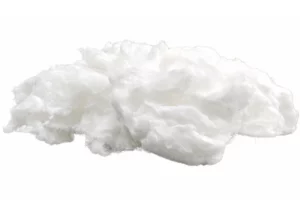
The newly formed fibers are collected on a moving conveyor or drum, forming a loose, cotton-like fiber mat (sometimes still referred to at this stage as “bulk fiber” — itself a separate commercial product used for packing and stuffing applications).

Step 4: Needling

The loose fiber mat is passed through a needle-punching machine, where thousands of barbed needles repeatedly push through the fiber layer. This mechanically interlocks the fibers into a cohesive, resilient blanket structure without the need for any binder or resin — needling is what gives ceramic fiber blanket its characteristic flexibility, tear resistance, and ability to recover thickness after compression.

Step 5: Cutting, Rolling, and Packaging

The finished blanket is trimmed to standard widths, cut to length or rolled into continuous rolls, and packaged — typically under vacuum compression to reduce shipping volume, since ceramic fiber blanket will spring back to close to its full manufactured thickness once unpacked and installed.

Key Classification Systems: Density and Temperature Grade

When comparing ceramic fiber blanket products, two specifications matter more than any others: density and temperature classification.

Classification by Density

Density is typically expressed in kg/m³ and directly affects both insulating performance and mechanical durability. Common commercial densities include:

  • 96 kg/m³ — the lightest common grade, offering good insulation value for low-load, non-vibrating applications where cost efficiency matters most
  • 128 kg/m³ — a widely used mid-range density, balancing insulation performance, handling durability, and cost for general industrial applications
  • 160 kg/m³ — a higher-density option offering improved mechanical strength, reduced shrinkage, and better resistance to erosion in higher-velocity gas flow environments
  • 192 kg/m³ — the highest common commercial density, used where maximum durability, minimum shrinkage, and resistance to mechanical stress or vibration are priorities, often in demanding furnace or kiln linings

As a general rule, higher density improves mechanical strength and reduces long-term shrinkage, but also reduces insulating efficiency per unit thickness and increases material cost and weight — so density selection is always a balance based on your specific application conditions.

Classification by Temperature Grade

Ceramic fiber blanket is also classified by its maximum continuous use temperature, which correlates directly with its fiber chemistry:

  • 1000°C class — general-purpose standard fiber for moderate-temperature insulation
  • 1260°C class — the most common commercial grade, standard aluminosilicate fiber suitable for the majority of industrial furnace and kiln applications
  • 1430°C class — zirconia-modified fiber for high-temperature furnace linings, kiln cars, and other demanding thermal processing equipment

It’s worth noting that the “temperature classification” typically refers to the fiber’s continuous use limit — the temperature at which the material maintains its structural and insulating properties over long-term service without excessive shrinkage or degradation. Many grades can briefly withstand higher peak temperatures, but sustained operation above the rated classification will accelerate shrinkage and shorten service life significantly.

Key Performance Properties

Low Thermal Conductivity

Ceramic fiber blanket’s defining performance characteristic is its low thermal conductivity, typically in the range of 0.1 to 0.3 W/m·K depending on density, mean temperature, and fiber grade. This allows relatively thin blanket sections to achieve significant temperature drops across the insulation layer, reducing heat loss and protecting furnace shells and structural steel from excessive temperatures.

Low Thermal Mass

Because ceramic fiber blanket is largely composed of trapped air rather than dense solid material, it has very low thermal mass compared to traditional insulating firebrick or castable refractory. This means far less energy is wasted heating up the insulation material itself during furnace startup — a major advantage for batch or cyclic furnace operations where rapid heating and cooling cycles are common.

Thermal Shock Resistance

Unlike rigid refractory materials, which can crack under rapid temperature changes, ceramic fiber blanket’s flexible, fibrous structure gives it excellent resistance to thermal shock, making it well suited to processes with frequent or rapid temperature cycling.

Chemical Stability

Standard ceramic fiber blanket resists attack from most industrial gases, oils, and greases, and shows good resistance to a wide range of chemical atmospheres, though it can be attacked by strongly alkaline environments, molten metals, and certain flux compounds — factors worth discussing with your supplier if your process involves aggressive chemical exposure.

Sound Absorption

The same fibrous, air-trapping structure that gives ceramic fiber blanket its thermal insulation properties also makes it an effective acoustic absorber, which is occasionally leveraged in combined thermal/acoustic insulation applications around high-temperature equipment.

Common Applications of Ceramic Fiber Blanket

Industrial Furnace and Kiln Lining

The single largest application for ceramic fiber blanket is as insulation lining inside industrial furnaces and kilns — either as a standalone lining material in lightweight furnace construction, or as a backup insulation layer behind a hot-face refractory brick or ceramic fiber module layer in more demanding installations.

High-Temperature Pipe and Duct Insulation

Ceramic fiber blanket is widely wrapped around high-temperature pipes, ducts, and flues carrying hot process gases, reducing heat loss and protecting personnel and surrounding equipment from surface burn hazards.

Expansion Joint Packing

Because it remains resilient and flexible even after repeated compression cycles, ceramic fiber blanket is commonly used to pack expansion joints in refractory-lined equipment, accommodating thermal expansion and contraction without cracking or gapping the way rigid materials would.

Fire Protection and Passive Fire Barriers

Certain grades of ceramic fiber blanket are used in passive fire protection applications, including fire-rated barriers, cable and pipe penetration seals, and structural steel fireproofing, taking advantage of the material’s high-temperature stability and low flame spread characteristics.

Automotive Catalytic Converter Mat

A specialized, precision-engineered form of ceramic fiber material is used as the mounting mat inside automotive catalytic converters, holding the ceramic substrate securely in place while accommodating thermal expansion during engine operation — a demanding application requiring very tight tolerances and consistent expansion (mat) pressure characteristics.

Backup Insulation Behind Ceramic Fiber Modules

In many large industrial furnace installations, ceramic fiber blanket serves as the cooler-zone backup insulation layer behind a hot-face ceramic fiber module lining, combining the durability of modules at the hot face with cost-efficient blanket insulation in the cooler zones further from direct flame or process exposure.

How to Choose the Right Ceramic Fiber Blanket

When specifying ceramic fiber blanket for a project, work through these key considerations:

Installation method — confirm whether your installation will use pin/stud anchoring, layered wrap construction, or another method, since this can influence the ideal blanket thickness and density selection.

Maximum operating temperature — select a fiber grade (standard, high-purity, or zirconia-modified) with a continuous use temperature comfortably above your actual process conditions, not just matched to peak temperature.

Mechanical and vibration exposure — higher-velocity gas flow, vibration, or mechanical handling typically calls for higher-density blanket to minimize erosion and long-term shrinkage.

Chemical exposure — confirm compatibility with any process gases, oils, or chemical vapors your insulation will be exposed to, particularly in applications involving alkaline compounds or molten metal contact.

Health and regulatory requirements — in jurisdictions with strict occupational exposure limits for refractory ceramic fiber, low biopersistent (AES) fiber may be required or strongly preferred.

The prev:

Related recommendations

Click Cancel to reply